

Even beginners who have just started importing food products, as well as intermediate importers with ongoing transactions, often find themselves thinking:
“Customs duties and consumption tax are higher than expected.”
Common situations seen frequently in actual customs clearance include:
- Importing goods without checking the applicable duty rate in advance
- Declaring under the general tariff even though a preferential tariff (0%) was available
- Assuming consumption tax is always a fixed cost and not considering deferral or refunds
Import costs directly affect profitability. However, all cost optimization must be based on procedures that are legal, accurate, and fully explainable.
This article explains concrete, lawful ways to reduce:
- Customs duties
- Consumption tax
with both beginner-friendly explanations and deeper insights for experienced practitioners.
Disclaimer:
This article is intended for general informational purposes only and does not guarantee outcomes for any specific transaction or customs determination. For actual import procedures, please confirm the latest laws, regulations, and instructions issued by customs and quarantine authorities.
- Basic Taxes Involved in Food Imports
- Legal Ways to Reduce Customs Duties and Consumption Tax
- Summary: How to Legally Reduce Customs Duties and Consumption Tax on Food Imports
- Reference Materials
Basic Taxes Involved in Food Imports
How Customs Duties Work
When importing food products, customs duties are imposed based on duty rates set by customs authorities for each product category.
Indicative examples:
- Cheese: 8%
- Chocolate: 10%
- Fruit: 0–5%
The duty rate is determined by the HS code (Harmonized System code).
What Is an HS Code?
The HS code is an internationally standardized product classification system consisting of six digits globally (nine digits in Japan).
It defines what the product is and therefore which duty rate applies.
Even for the same type of food, the duty rate may differ depending on processing level or intended use.
How Import Consumption Tax Works
At the time of importation, consumption tax (currently 10%) is imposed, just like on domestic transactions.
Calculation formula:
Import Consumption Tax = (Taxable Value + Customs Duty) × 10%
Items included in the taxable value:
- Product price
- Ocean or air freight
- Insurance premium
The total of these elements is referred to as the CIF value.
What Is CIF?
CIF (Cost, Insurance and Freight) refers to the import value that includes:
product cost + insurance + freight.
👉 Key point:
Lower customs duties also reduce consumption tax.
In other words, customs duty optimization leads directly to consumption tax optimization.
For a comprehensive understanding of food import procedures and quarantine requirements, see MAFF Basics of Food Import & Quarantine
Legal Ways to Reduce Customs Duties and Consumption Tax
1. Utilize Preferential Tariffs (FTA / EPA) 【Most Important】
Japan has concluded numerous Free Trade Agreements (FTAs) and Economic Partnership Agreements (EPAs) with other countries.
By using these agreements:
- Standard duty rates can be reduced
- In some cases, customs duty becomes 0% (duty-free)
Examples:
- Japan–Australia EPA: Reduced duties on beef and dairy products
- Japan–Thailand EPA: Reduced duties on fruits and processed foods
Advanced Insight: Types of Preferential Duty Exemptions
- Immediate tariff elimination under EPA
→ Duty-free from the date the agreement enters into force - Accumulation (cumulation) rules
→ Duty-free treatment even when materials originate from multiple countries, as long as they are within the EPA region - Generalized System of Preferences (GSP)
→ Certain products are duty-free even from countries without an EPA - Least Developed Country (LDC) preferences
→ Almost all products are duty-free
👉 Always question: “Is this food product truly subject to duty?”
Practical Points
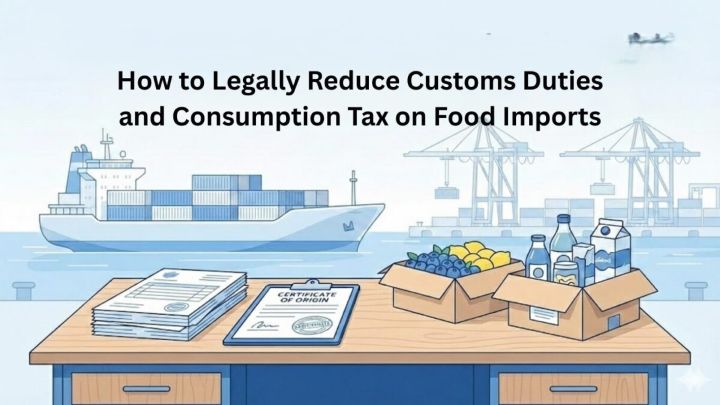
- Obtain a Certificate of Origin (CO) without fail
- Ensure the HS code matches the contract and commercial invoice
- Confirm that origin criteria (regional value content or processing requirements) are satisfied
What Is a Certificate of Origin (CO)?
A document certifying where the product was produced or processed.
It is effectively the “entry ticket” for applying preferential tariffs.
Customs duties and consumption tax are critical elements of import operations.
For more information, see this article.
→ Certificates of Origin for Food Imports: Complete Guide for Importers
Calculate import duties accurately and consider preferential tariffs using the resources from Japan Customs and JETRO FTA/EPA Guide.
2. Accurate HS Code Classification
Incorrect HS classification can result in:
- Paying higher duties than necessary
- Denial of preferential tariff treatment
Practical example:
Misclassifying chocolate as “confectionery” instead of “food ingredients”
→ Duty rate changes from 10% to 5%
👉 This illustrates how significantly tax rates can vary depending on HS classification.
Consult customs consultation desks or licensed customs brokers to determine the most accurate and advantageous classification.
For more information, see this article.
→ How to Find HS Codes for Beginners: 3 Common Mistakes to Avoid
3. Proper Optimization of CIF Value
Both customs duties and consumption tax are calculated based on the CIF value.
By reviewing:
- Freight charges
- Insurance costs
it is possible to indirectly reduce the tax burden.
Important caution:
- Declaring values below actual costs constitutes illegal under-declaration
- Optimization must remain reasonable and fully justifiable
4. Consumption Tax Deferral and Refund Strategies 【Advanced】
✔ Input tax credit
Consumption tax paid at import can generally be fully credited.
👉 In practice, it functions as a temporary cash outlay, not a permanent cost.
✔ Refunds related to exports
In cases such as:
- Import → domestic storage → export
- Cross-border e-commerce
consumption tax may be refundable.
✔ Use of bonded systems
While goods are stored in a bonded warehouse, neither customs duty nor consumption tax is levied.
👉 A powerful tool for high-value food products or goods intended for re-export.
5. Bulk Purchasing and Logistics Optimization
- Consolidated shipments instead of small-lot imports
- Ocean freight instead of air freight
These measures reduce:
- Freight costs
- Customs brokerage fees
- CIF value
which ultimately lowers the overall tax burden.
Summary: How to Legally Reduce Customs Duties and Consumption Tax on Food Imports
- Customs duties and consumption tax can be legally minimized through proper use of HS codes, CIF valuation, and preferential tariffs
- Applying preferential tariffs requires Certificates of Origin and strict compliance with conditions
- Consumption tax should be viewed not as a fixed cost, but as eligible for deferral or refunds
- Illegal declarations and under-reporting must be strictly avoided
For detailed explanations by common practical issues, see:
When Food Imports Are Subject to Mandatory Inspection and How to Avoid It
👉 Cases Where Food Imports Are Subject to Mandatory Inspection and How to Prevent Delays — High-Risk Products and Practical Checkpoints
Definitive Guide to Food Import Preparation & Ingredient Labeling in Japan
👉Essential Preparation Checklist Before Starting Food Imports and Key Points to Avoid Mistakes in Ingredient Labeling
Reference Materials
- Japan Customs (Ministry of Finance): Import Tariff Schedules and HS Code Search
https://www.customs.go.jp/english/tariff/index.htm - JETRO – EPA/FTA Information (Japan External Trade Organization)
- EPA/FTA overview and tariff data (English & Japanese)
https://www.jetro.go.jp/themetop/wto-fta/ - METI – Ministry of Economy, Trade and Industry (EPA/FTA Overview)
- EPA/FTA (Trade Policy) – Japanese Government (policy & procedures) https://www.meti.go.jp/english/index.html