

Disclaimer:
This article is intended for general informational purposes only and does not guarantee outcomes for any specific transaction or customs determination. For actual import procedures, please confirm the latest laws, regulations, and instructions issued by customs and quarantine authorities.
- “Why Is My Food Shipment Stuck at Japanese Customs?”
- Why Food Imports Face More Problems at Japanese Customs
- 10 Common Food Import Customs Problems in Japan (Causes & Solutions)
- 1: Incomplete or Incorrect Commercial Invoice
- 2: Incorrect HS Code Classification
- 3: Missing Food Import Notification (MHLW)
- 4: Shipment Selected for Inspection (Delays)
- 5: Ingredient Labeling Not Compliant with Japanese Standards
- 6: Country of Origin (COO) Issues or Misrepresentation
- 7: Use of Prohibited or Restricted Ingredients
- 8: Mismatch Between Cargo and Documents
- 9: China-Specific Issue — Documentation Is “Correct” but Explanations Are Insufficient
- 10: Relying Entirely on Forwarders or Brokers
- Best Practices to Prevent Food Import Problems in Japan
- Conclusion: Food Import Success in Japan Depends on Preparation
- References
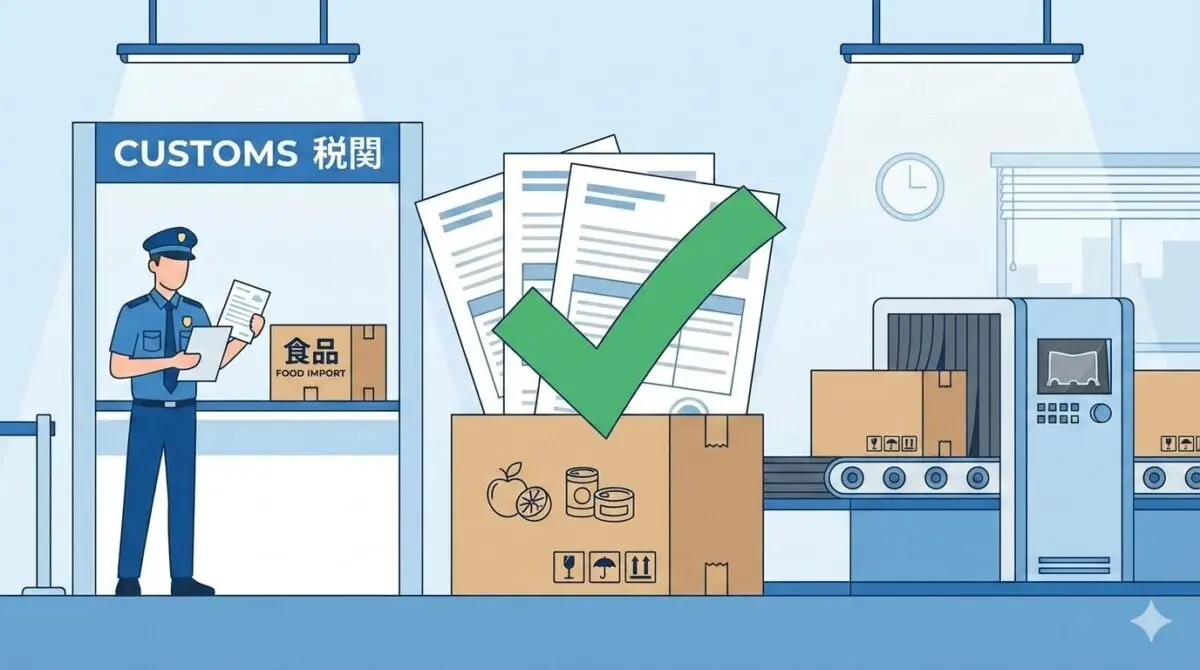
“Why Is My Food Shipment Stuck at Japanese Customs?”
“I shipped food products to Japan, but customs clearance suddenly stopped.”
“The forwarder says there’s a documentation issue, but I don’t understand what’s wrong.”
These are very common problems for foreign exporters and importers shipping food to Japan, especially for first-time or early-stage shipments.
In reality, most food import troubles are not caused by bad intent, but by misunderstandings of Japan’s strict and unique food import regulations.
This article explains the 10 most common customs clearance problems encountered when importing food into Japan, clearly structured as:
- Why the problem occurs
- How to resolve it
- How to prevent it in future shipments
The focus is on English-speaking exporters and importers who want to sell food products in Japan smoothly and compliantly.
Why Food Imports Face More Problems at Japanese Customs
Unlike general merchandise, food imports into Japan are regulated by multiple authorities, including:
- Japan Customs
- Quarantine Stations under the Ministry of Health, Labour and Welfare (MHLW)
As a result, food shipments require both customs clearance and food safety clearance, which significantly increases scrutiny.
Additionally, foreign exporters—especially those shipping from China or Southeast Asia—often face issues because:
- Documentation standards differ from Japanese expectations
- HS codes are interpreted differently
- Ingredient and labeling rules are far stricter in Japan
Before starting food imports, it’s essential to review the official MHLW Food Import Procedures to ensure compliance and avoid quarantine delays.
10 Common Food Import Customs Problems in Japan (Causes & Solutions)
Below are the most frequent issues, based on actual import cases.
1: Incomplete or Incorrect Commercial Invoice
Cause
- Product description too vague (e.g., “Food,” “Snack”)
- No ingredient list or processing explanation
- Quantity or weight mismatch with Packing List or B/L
Solution
- Use detailed product descriptions (product name + use)
- Clearly state ingredients and processing method
- Ensure consistency across Invoice, Packing List, and Bill of Lading
Prevention
➡ Provide a Japan-specific invoice template to your supplier
(Do not rely on generic export invoices)
2: Incorrect HS Code Classification
Cause
- Using the supplier’s HS code without verification
- Misclassification between similar food categories
Solution
- Recheck HS codes based on Japan’s tariff schedule
- Use Advance Ruling (Pre-classification) if uncertain
Prevention
➡ Be able to explain why a specific HS code applies
For more information, see this article.
→ How to Find HS Codes for Beginners: 3 Common Mistakes to Avoid
3: Missing Food Import Notification (MHLW)
Cause
- Assuming small quantities are exempt
- Lack of knowledge about Japan’s Food Sanitation Act
Solution
- Submit a Food Import Notification to the Quarantine Station
- Confirm procedures with a customs broker or forwarder
Prevention
➡ Assume all food products require notification unless confirmed otherwise
You might also find this article helpful.
→ Common Quarantine Issues in Food Imports and How to Handle Them | Food-Specific Checklist Included
4: Shipment Selected for Inspection (Delays)
Cause
- Use of additives, supplements, or new ingredients
- High-risk origin countries (including China)
Solution
- Expect inspection lead time (1–2 weeks or more)
- Adjust sales and inventory schedules accordingly
Prevention
➡ Start with small test shipments to build import history
5: Ingredient Labeling Not Compliant with Japanese Standards
Cause
- Using original foreign-language labels
- Additives not approved in Japan
Solution
- Verify ingredients under Japanese Food Labeling Standards
- Obtain detailed formulations and ratios
Prevention
➡ Create Japanese-compliant labels under importer control
For more information, see this article.
→ Definitive Guide to Food Import Preparation & Ingredient Labeling in Japan
“Make sure your food import process starts off correctly—check out our Essential Preparation Checklist Before Starting Food Imports to avoid common ingredient labeling mistakes.”
When designing Japanese food labels, follow the CAA Food Labeling System for proper ingredient listing and allergen information.
6: Country of Origin (COO) Issues or Misrepresentation
Cause
- Processing country differs from raw material origin
- Insufficient COO documentation
Solution
- Clarify manufacturing and processing flow
- Obtain proper COO documentation
Prevention
➡ Prepare documents explaining where and how processing occurs
You might also find this article helpful.
→ Certificates of Origin for Food Imports: Complete Guide for Importers
7: Use of Prohibited or Restricted Ingredients
Cause
- Unapproved additives or herbal materials
- Health food or supplement ingredients
Solution
- Shipment may require re-export or destruction
- Review ingredients thoroughly before future shipments
Prevention
➡ Require a full ingredient list before production
For a full English version of Japan’s food safety law, refer to the official Food Sanitation Act translation at the Japanese Law Translation website: https://www.japaneselawtranslation.go.jp/en/laws/view/5024. This outlines basic safety, labeling, additive controls, and inspection provisions that apply to imported food.
8: Mismatch Between Cargo and Documents
Cause
- Product specification changed without notice
- Packaging quantity or weight discrepancies
Solution
- Cooperate with physical inspection
- Submit corrected declarations
Prevention
➡ Conduct final shipment confirmation and photo checks
9: China-Specific Issue — Documentation Is “Correct” but Explanations Are Insufficient
Cause
- Belief that formal documents alone are enough
- Inability to explain product details to Japanese authorities
Solution
- Submit supplementary explanatory documents in Japanese or English
Prevention
➡ Become an importer/exporter who can clearly explain the product
10: Relying Entirely on Forwarders or Brokers
Cause
- Complete outsourcing without understanding procedures
- Importer does not review documents
Solution
- Personally review all import documents
- Ask brokers to explain issues clearly
Prevention
➡ Remember: The legal responsibility lies with the importer of record
For a comprehensive understanding of food import procedures and quarantine requirements, see MAFF Basics of Food Import & Quarantine.
Best Practices to Prevent Food Import Problems in Japan
- Always start with small test shipments
- Prepare documents according to Japanese standards, not local ones
- Personally understand HS codes and ingredients
- For China exports, prioritize clear explanations over paperwork alone
Related topics:
- “Food Import Documentation Checklist for Japan”
- “HS Code Classification for Food Products in Japan”
Conclusion: Food Import Success in Japan Depends on Preparation
Most food import problems in Japan are entirely preventable.
Key success factors include:
- Accurate invoices and HS codes
- Full ingredient transparency
- Proper labeling and inspection readiness
- Understanding Japan’s regulatory mindset
Taking time to prepare and explain your products properly will lead to smooth, repeatable imports and long-term business success in Japan.
References
- Ministry of Health, Labour and Welfare – Import Procedure under Food Sanitation Law (Japan)
Official guidance on import notification requirements under Japan’s food safety law.
https://www.mhlw.go.jp/english/topics/importedfoods/1.html - Japan Customs – Customs Confirmation Requirements under the Food Sanitation Law (FAQ)
Japan Customs explanation on how food imports must comply with the Food Sanitation Law before clearance.
https://www.customs.go.jp/english/c-answer_e/imtsukan/1802_e.htm - FAO / Globefish – Import Notifications for Food Products in Japan
Overview of import notification and quarantine stations involved in food import oversight.
https://www.fao.org/in-action/globefish/markets—trade/import-notifications-for-fisheries-and-aquaculture-products/import-notification—japan/en