

Key Points for Small-Volume Sample Imports and Duty Reduction
- Why Is Food Importing Considered Difficult?
- Why Food Imports Are Challenging
- Practical Example of Small-Volume Sample Imports
- Food Items Eligible for the 60% Rule in Personal Imports
- Detailed Guide to the Food Import Process
- Tips for Beginners to Import Safely
- Legal Ways to Reduce Customs Duties and Consumption Tax
- Summary: Importing Food Is Possible Even for Individuals
- Reference Materials
- 📌 Explanation of Taxes on Personal Imports and the 60% Rule
- 📌 Official Information on Food Safety and Quarantine
Why Is Food Importing Considered Difficult?
A common misconception among beginners is that “if the quantity is small, it can be treated as personal importation.”
For example, some assume that “importing just 1 kg of dried fruit or spices would qualify for the 60% rule and reduce customs duties.”
⚠️In reality, food products are subject to strict regulations under food safety laws, quarantine controls, and customs regulations. As a general rule, food imports are not permitted as personal imports.
Why Food Imports Are Challenging
Regulations Under Japan’s Food Sanitation Framework
(Equivalent to food safety and sanitary regulations in other countries)
- Fresh and processed foods must be reported to quarantine authorities and customs.
- Health certificates, sanitary certificates, or laboratory inspections may be required.
Easily Classified as Commercial Imports
- Even small quantities may be deemed commercial if imports are repeated.
- Documentation such as the commercial invoice, HS code, or the use of a company name can result in the shipment being treated as a commercial import.
Conditional Duty Reduction for Personal Imports (The “60% Rule”)
- If it is clearly for personal consumption and in small quantities, the taxable value may be reduced to 60%.
- Whether this applies is entirely at the discretion of customs authorities.
For a detailed explanation of the difference between personal and commercial imports, see the following article:
→ Differences Between Personal and Commercial Imports: Required Documents, Costs, Tax Rates, and Common Issues (Beginner-Friendly Guide)
Practical Example of Small-Volume Sample Imports
Case Study: Small Sample Import of Dried Mango
- Product: Dried mango
- Purpose: Test samples for domestic buyers
- Quantity: Approximately 1 kg
- Importer: Company name
- Transportation: Air freight
- Documents: Commercial invoice listing product name, quantity, and HS code
Typical Flow
- Small-lot packaging and labeling overseas
- Shipment by air
- Clearance through customs and food quarantine
- Use for buyer evaluation and tasting
- Formal customs clearance for full-scale import after evaluation
Key Point: Even first-time importers can safely import food if the documentation and procedures are handled correctly.
Benefit: Small-volume sample imports are an effective step to lower the entry barrier to food importing.
Food Items Eligible for the 60% Rule in Personal Imports
⚠️The following examples indicate cases where a reduced taxable value may be applied at the discretion of customs authorities, provided that the goods are clearly for personal consumption.
Such treatment is not automatically granted in all cases.
If personal consumption is clearly demonstrated, the taxable value may be reduced to 60%. The following food categories are more likely to qualify.
Dried and Processed Foods
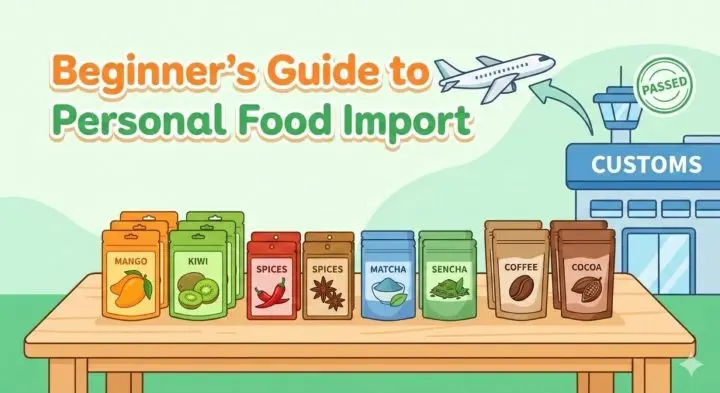
- Dried fruits (mango, apricot, papaya, etc.)
- Instant coffee and tea
- Cereals, pasta, and grains
- Small quantities of cookies and chocolate
Seasonings and Sauces
- Olive oil and balsamic vinegar
- Soy sauce, miso, ketchup, mustard
- Spices and herbs
Beverages and Powders
- Powdered juice and protein powder
- Tea leaves (green tea, herbal tea, etc.)
Items Difficult to Qualify
- High-value alcoholic beverages and certain processed foods
- Fresh fruits and vegetables (subject to plant quarantine)
- Meat products and some cheeses (subject to animal quarantine)
Key Point: Shelf-stable, dried, or processed foods are the primary candidates. For small quantities clearly intended for personal use, the 60% rule may apply.
Detailed Guide to the Food Import Process
For a comprehensive explanation of required procedures and quarantine steps, see:
→ Complete Guide to Food Import Procedures and Quarantine Requirements
Tips for Beginners to Import Safely
- Proper documentation is mandatory, even for small quantities.
- Treat first-time or evaluation imports as a “low-risk entry step.”
- Ensure accuracy in documents, quantities, and HS codes.
- Starting small helps build experience and confidence.
For more information on HS codes, see:
→ How to Find HS Codes: Three Common Mistakes Beginners Make
Legal Ways to Reduce Customs Duties and Consumption Tax
Use of Tariff Rates and Rules of Origin
- Applying EPA (Economic Partnership Agreements) or FTAs can reduce duties to 0–a few percent.
- Proper HS code classification may allow lower duty rates.
- Example: Dried fruit from Thailand imported under an EPA may be duty-free (0%).
Optimize Import Structure
- Import raw materials and process domestically.
- For initial testing, import only packaging or containers and source food domestically.
Distribute Import Planning
- Reduce the number of import shipments.
- Conduct bulk testing overseas and import only final selected products.
Summary: Importing Food Is Possible Even for Individuals
- Food imports are generally not permitted as personal imports, but small-volume sample imports for evaluation purposes are feasible.
- Dried and processed foods, seasonings, and powdered beverages may qualify for the 60% rule.
- With proper procedures and a small-scale start, the barriers to food importing can be significantly reduced.
- Even beginners can safely explore food importing by starting with small sample shipments.
⚠️This article is intended for general informational purposes only.
For specific import eligibility or applicable duty and tax rates, please be sure to consult customs authorities, quarantine offices, or a qualified professional.
Reference Materials
Japan Customs: Simplified Tariff System for Low-Value Imports
(Relevant to personal imports)
→ Explains the simplified tariff system applicable to low-value shipments.
https://www.customs.go.jp/tsukan/kanizeiritsu.htm
Japan Customs: Overview of Tariffs and Duty Rates
→ Official explanation of tariff structures and customs duty and consumption tax systems.
https://www.customs.go.jp/english/summary/tariff.htm
Japan Customs FAQ (Personal Imports and Customs Procedures)
→ Frequently asked questions on customs clearance, duty exemptions, and simplified tariffs.
https://www.customs.go.jp/english/c-answer_e/customsanswer_e.htm
📌 Explanation of Taxes on Personal Imports and the 60% Rule
Customs Duties, Consumption Tax, and Taxable Value for Personal Imports (60% Rule Explained)
→ A practical guide detailing taxable value calculations and simplified tariff systems.
https://japan-import-guide.com/ja/personal-import-duty-calculation-60rule/
This article provides a practice-oriented explanation and includes specific calculation formulas for the 60% rule.
📌 Official Information on Food Safety and Quarantine
Ministry of Health, Labour and Welfare: Food Import Procedures
→ Official explanation of food import notifications and inspection requirements.
https://www.mhlw.go.jp/stf/seisakunitsuite/bunya/0000144562.html