

This article summarizes general regulatory frameworks and practical tendencies and does not guarantee the acceptability or processing time of individual cases. Final decisions should be made in accordance with the instructions of the competent animal quarantine office and customs authorities.
- Summary of Practical Considerations
- Introduction
- Assumed Import Scenario
- Required Documents for Importing Freeze-Dried Pork from Thailand
- Is Japanese Animal Quarantine Still Required If You Have a DLD Certificate?
- Estimated Time from Animal Quarantine to Customs Clearance
- Practical Pitfalls and Common Misunderstandings
- Summary: Key Compliance Points for Importing Pork Products from Thailand
- References
Summary of Practical Considerations
Thai freeze-dried pork products intended for human consumption are, in general, subject to animal quarantine inspection upon arrival in Japan, even if they are processed products.
A DLD certificate (animal health certificate issued by the Department of Livestock Development of Thailand) is a prerequisite document for undergoing animal quarantine inspection in Japan; however, it does not imply exemption from quarantine procedures.
If there are no issues with the documentation or manufacturing conditions, the animal quarantine inspection and customs clearance may be completed on the same day or within a few business days. That said, the required time and feasibility may vary depending on the port of entry and the judgment of the relevant quarantine office.
Conducting prior consultation and submitting a copy of the DLD certificate in advance tends to facilitate a smoother confirmation process after arrival.
Introduction
“Why is animal quarantine still required in Japan even though we have an official government certificate?”
“Will animal quarantine delay customs clearance for several days?”
These are very common concerns among importers when bringing processed pork products into Japan from overseas, especially from countries such as Thailand.
In practice, misunderstandings such as the following often cause delays:
- Assuming freeze-dried products can be cleared easily without strict checks
- Believing that an EPA Certificate of Origin (COO) alone is sufficient
- Waiting until after arrival to submit quarantine and food safety documents
Such misconceptions can lead to customs delays, higher bonded warehouse charges, or even re-export or disposal.
This article provides a practical and neutral explanation for importers at a beginner to intermediate level, focusing on:
- Required documents for importing freeze-dried pork from Thailand
- The role of the DLD certificate and Japanese animal quarantine
- Realistic timelines from arrival to customs clearance
- Key compliance points from an operational perspective
The explanation is based on a typical case of HS Code 1602.49 (prepared or preserved pork).
Assumed Import Scenario
- Product: Freeze-dried pork chips
- Intended use: Human food
- Country of origin: Thailand
- HS Code: 1602.49
- Trade framework: Japan–Thailand Economic Partnership Agreement (JTEPA)
Note: Requirements may differ depending on product specifications or end use (e.g. pet food).
Required Documents for Importing Freeze-Dried Pork from Thailand
Core Documents for Customs Clearance
| Document | Purpose |
| Commercial Invoice | Value and product description |
| Packing List | Quantity and weight |
| Bill of Lading / Air Waybill | Proof of transport (FOB / CIF basis) |
| DLD Certificate | Animal quarantine |
| Food Import Notification | Food safety compliance |
| Certificate of Origin (JTEPA COO) | Preferential duty (if applicable) |
Learn more about Certificates of Origin and how they work in import procedures in our detailed guide [Certificates of Origin for Food Imports: Complete Guide for Importers].
What Is the DLD Certificate?
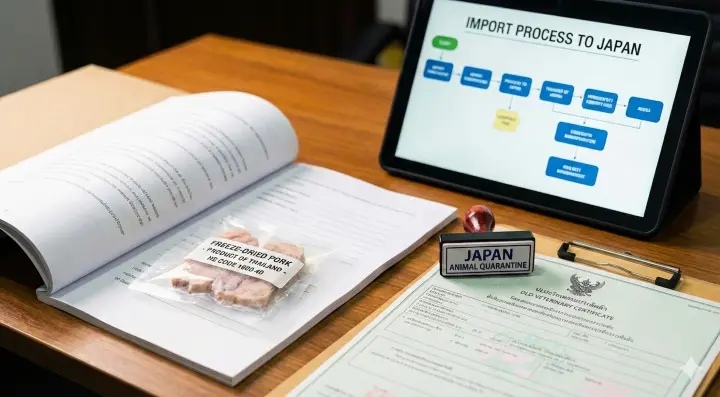
The DLD Certificate is a Veterinary Health Certificate issued by the Department of Livestock Development (DLD) of Thailand.
It certifies, among other things, that:
- The product is derived from pork
- The raw materials originate from livestock managed under disease control programs
- The manufacturing facility is approved for export to Japan
- The heat treatment process (temperature and duration) is clearly specified
The DLD Certificate is not an exemption from Japanese quarantine.
Rather, it is a mandatory prerequisite for Japanese animal quarantine review.
Is Japanese Animal Quarantine Still Required If You Have a DLD Certificate?
Conclusion: Yes, Animal Quarantine in Japan Is Mandatory
In Japan, pork and pork products are designated as controlled items under animal health regulations aimed at preventing livestock diseases.
Therefore, imports are subject to a two-step verification process:
- Certification by the exporting country authority (Thailand DLD)
- Animal quarantine inspection upon arrival in Japan, conducted by Japan’s Animal Quarantine Service (AQS)
Having a DLD Certificate allows the Japanese inspection to be conducted primarily as a documentary review, but it does not eliminate the requirement.
Differences Between Animal Quarantine, Food Notification, and Customs
Importers often confuse these procedures because they are handled at the same port or airport.
| Procedure | Authority | Purpose |
| Animal Quarantine | Ministry of Agriculture (AQS) | Livestock disease prevention |
| Food Import Notification | Ministry of Health | Food safety and ingredients |
| Customs Clearance | Japan Customs | Import approval and duties |
Each process serves a different regulatory objective and must be completed independently.
Estimated Time from Animal Quarantine to Customs Clearance
Typical Lead Time (Indicative)
| Situation | Estimated Time |
| No issues in documentation | Same day to next business day |
| Additional confirmation required | 1–3 business days |
| Non-compliance identified | Re-export or disposal |
Actual timelines may vary depending on port congestion, submission timing, and whether prior consultation was conducted.
Best Timing for Document Submission
| Document | Recommended Timing |
| DLD Certificate (copy) | Immediately after shipment |
| Food Import Notification | 2–3 days before arrival |
| DLD Certificate (original) | Upon arrival |
Following this schedule often enables release on the day of arrival or the next business day.
Practical Pitfalls and Common Misunderstandings
Points Where Importers Often Make Mistakes
- Assuming freeze-dried products do not require heat treatment evidence
- Using vague wording in the DLD Certificate (e.g. “sufficiently heated”)
- Fixating on HS 1602.49 without considering classification risk
- Believing an EPA COO automatically reduces duty
Note: Final HS classification is determined by Customs. Depending on ingredients and processing, reclassification may occur.
To avoid classification mistakes, see our guide on using advance rulings for HS code determination
[How to Find HS Codes for Beginners: 3 Common Mistakes to Avoid].
Check out our article on how to utilize EPA for import duty savings [How to Legally Reduce Customs Duties and Consumption Tax on Food Imports].
Summary: Key Compliance Points for Importing Pork Products from Thailand
- The DLD Certificate is mandatory, but it does not waive Japanese quarantine
- Animal quarantine inspection in Japan is always required
- Processed pork products generally clear quarantine faster than raw meat
- Advance submission and prior consultation significantly reduce risk
- Final regulatory decisions rest with Japanese authorities
The priority is not speed, but ensuring the shipment does not get stopped.
References
- Japan Animal Quarantine Service (MAFF)
https://www.maff.go.jp/aqs/languages/info.html - Ministry of Health, Labour and Welfare – Food Import Procedures
https://www.mhlw.go.jp/stf/english/index.html - Japan Customs
https://www.customs.go.jp/english/index.htm - Department of Livestock Development, Thailand
https://www.dld.go.th/