

— A Practical Food Import Checklist to Prevent Customs Delays, Quarantine Issues, and Sales Suspension —
Disclaimer:
This article is intended for general informational purposes only and does not guarantee outcomes for any specific transaction or customs determination. For actual import procedures, please confirm the latest laws, regulations, and instructions issued by customs and quarantine authorities.
- Food Imports Are a Field Where “Lack of Preparation = No Customs Clearance”
- Essential Preparation Checklist for Food Imports: The Big Picture
- Step 1: Confirm First Whether the Product Can Be Imported as Food
- Step 2: Verify Ingredients and Additives in Detail Before Importing
- Step 3: Build Your Schedule Around the Food Import Notification
- Practical Points to Avoid Mistakes in Ingredient Labeling
- Practical Advice to Prevent Food Import Failures
- Summary: In Food Imports, Preparation and Ingredient Labeling Are Everything
- Reference Materials
Food Imports Are a Field Where “Lack of Preparation = No Customs Clearance”
Among beginners starting food imports and even experienced practitioners, the following comments are commonly heard on the ground:
- “All the invoices were ready, but the shipment was stopped at quarantine.”
- “I thought I could prepare the ingredient label later.”
- “The ingredients are common overseas, but they were not allowed in Japan.”
Food importing is a field where success or failure is largely determined before the goods are shipped.
In particular, underestimating:
👉 Ingredient verification
👉 Food labeling (Japanese-language labels)
can result in products that cannot be sold even after customs clearance.
This article provides a field-based explanation for beginner to intermediate importers, covering:
- A mandatory preparation checklist before starting food imports
- Practical points to avoid mistakes in ingredient labeling
Before starting food imports, it’s essential to review the official MHLW Food Import Procedures to ensure compliance and avoid quarantine delays.
Essential Preparation Checklist for Food Imports: The Big Picture
80% of Food Import Preparation Happens Before Importation
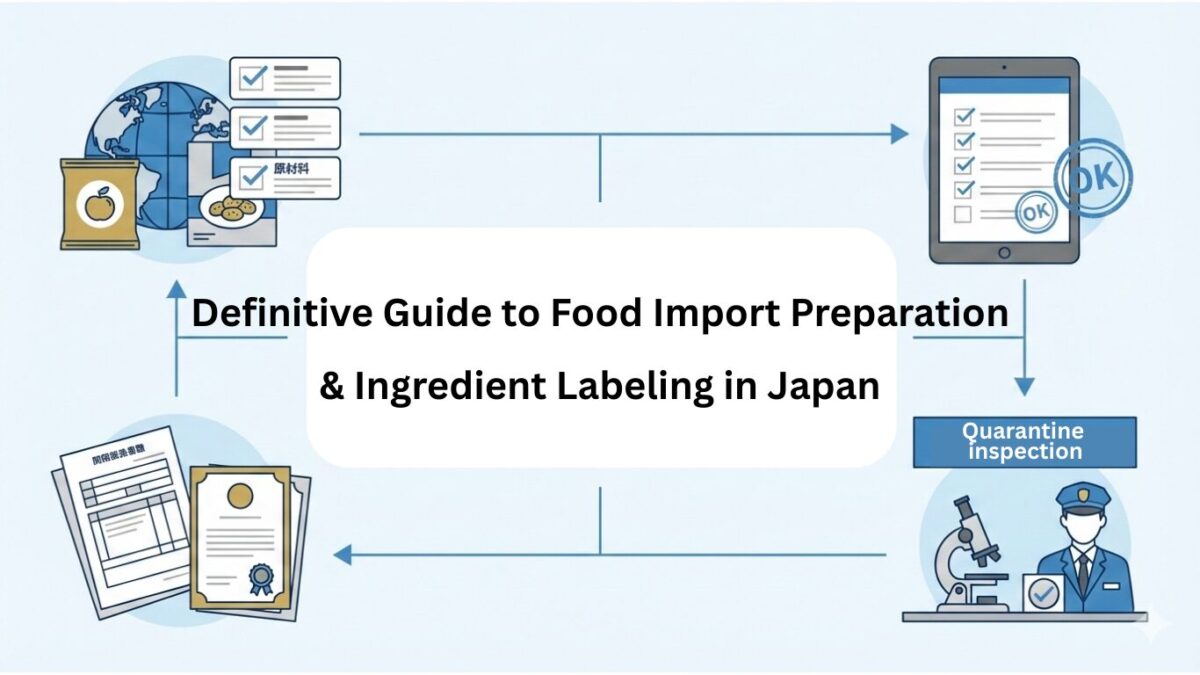
At a minimum, food importers must complete the following five steps:
- Confirm whether the product is legally importable as food in Japan
- Thoroughly verify ingredients and food additives
- Confirm whether a Food Import Notification is required
- Design Japanese-compliant food labeling (ingredient labeling)
- Understand customs clearance and quarantine timelines
👉 All of these must be completed before the goods are shipped.
Step 1: Confirm First Whether the Product Can Be Imported as Food
“Food Overseas” Does Not Automatically Mean “Food in Japan”
The first checks in food importing are:
- Whether the product is legally treated as food in Japan
- Whether it contains ingredients prohibited under Japan’s Food Sanitation Act
- Whether it falls under food, or is classified as a health food or dietary supplement
Common Misconceptions in Practice
- “It’s sold in local supermarkets, so it must be fine.”
- “It’s approved in the EU or the U.S., so it should be acceptable.”
👉 Japan has many unique food regulations, and these factors alone are not sufficient for decision.
Step 2: Verify Ingredients and Additives in Detail Before Importing
Information You Must Obtain from the Manufacturer
Without the following information, shipments are likely to be stopped at quarantine:
- Full ingredient list (composition ratio or listed in descending order by weight)
- Official names and functions of food additives
- Manufacturing process (a simplified description is acceptable)
- Allergen information
👉 The basic rule is: “Obtain the full ingredient details first, then determine import eligibility.”
Even Trace Additives Can Be Rejected
This is the most frequent source of trouble in actual operations.
- Preservatives or colorants commonly used overseas
- Additives used only in trace amounts
- Ingredients described as “natural” or “plant-derived”
👉 If an additive is not approved in Japan, it is prohibited regardless of quantity.
If discovered after import, this can lead to:
- Disposal of the goods
- Re-export to the country of origin
- Suspension of future imports
Step 3: Build Your Schedule Around the Food Import Notification
Quarantine Is Mandatory Before Customs Clearance
For food imports, a Food Import Notification must be submitted to the quarantine station before customs clearance.
- Submitted by: The importer or a licensed customs broker
- Required documents:
- Food Import Notification form
- Commercial invoice
- Ingredient list and manufacturing process description
👉 Missing or incomplete documents can immediately halt customs clearance.
Practical Points to Avoid Mistakes in Ingredient Labeling
Ingredient Labeling Is Not “Translation” — It Must Be Rebuilt for Japan
Simply translating overseas packaging into Japanese is insufficient.
Why:
- Ingredient order must follow descending weight rules
- Additive labeling methods differ
- Collective or functional naming may be required
Practical advice:
👉 Treat overseas labels as reference materials only
👉 Redesign labeling in full compliance with Japanese food labeling regulations
When designing Japanese food labels, follow the CAA Food Labeling System for proper ingredient listing and allergen information.
Do Not Forget: The Importer Is the Responsible Labeling Party
When selling food products in Japan, labeling must include:
- Importer’s name
- Japanese domestic address
This applies even to side businesses or individual importers.
👉 The importer bears full legal responsibility for the labeling.
Ingredient Checks Are Required Even for Sample Imports
- “It’s just a sample, so I’ll deal with labeling later.”
👉 This approach does not work for food imports.
Even at the sample stage, it is safest to conduct:
- Ingredient verification
- Additive checks
- Food Import Notification (if applicable)
Practical Advice to Prevent Food Import Failures
Use Advance Consultations with Quarantine Stations and Customs Brokers
Consultation is strongly recommended in the following situations:
- Handling a new category of food
- Uncertainty about ingredients or additives
- Insufficient information from overseas manufacturers
👉 Avoid self-judgment — advance consultation is the fastest and safest route.
Calculate import duties accurately and consider preferential tariffs using the resources from Japan Customs and JETRO FTA/EPA Guide.
Summary: In Food Imports, Preparation and Ingredient Labeling Are Everything
Key points to remember:
✅ 80% of food import success depends on pre-import preparation
✅ Ingredients and additives must be verified in advance
✅ Ingredient labeling must be rebuilt according to Japanese rules
✅ Treat samples as food imports from the outset
✅ Consult quarantine authorities or professionals when in doubt
For a comprehensive understanding of food import procedures and quarantine requirements, see MAFF Basics of Food Import & Quarantine
Reference Materials
- Ministry of Health, Labour and Welfare (Quarantine Stations): Food Import Procedures
https://www.mhlw.go.jp/english/topics/importedfoods/index.html - Consumer Affairs Agency: Food Labeling System
https://www.caa.go.jp/en/policy/food_labeling/ - Japan Customs: Import Customs Clearance Procedures
https://www.customs.go.jp/english/c-answer_e/imtsukan/1201_e.htm