


This article is intended primarily for:
- Companies bringing food samples into Japan for overseas exhibitions, product development, or internal evaluation
- Import compliance staff and sales personnel involved in food-related business activities
- Introduction
- Executive Summary (Key Practical Takeaways)
- Why This Topic Causes Confusion
- Key Terminology to Fix First (Important)
- What “Non-Applicable” Means in Practical Import Operations
- Decision Axis ①: What Does “No Import Declaration Required” Mean?
- Decision Axis ②: Conditions Under Which Food Samples Are Often Treated as Not Requiring a Food Import Notification
- Decision Axis ③: Hand-Carrying Is Not “Easy” — Responsibility Is Heavier
- Decision Axis ④: Very Limited Cases Close to “No Declaration Required”
- Overall Flow of Import Declaration for Hand-Carried Food Samples
- What Must Be Prepared in Advance (Most Important)
- Completing the “Declaration of Accompanied Articles” on the Aircraft
- Summary: Handling Hand-Carried Food Samples
- Q&A (Frequently Asked Practical Questions)
- Reference Materials
Introduction
This article summarizes how decisions are commonly made in practice when bringing food samples into Japan through airport quarantine offices.
Rather than explaining statutory provisions line by line, it focuses on how quarantine offices, customs, and customs brokers tend to assess cases in real-world operations.
The content is based on extensive experience coordinating in advance with quarantine offices, customs authorities, and licensed customs brokers.
It reflects general operational tendencies and does not guarantee approval, exemption, or outcomes for any specific case.
Final determinations must always follow the instructions of the competent quarantine office and customs authority.
Executive Summary (Key Practical Takeaways)
Practical Conclusion
Even when food samples are imported solely for exhibition, internal evaluation, testing, or disposal, they are still considered “food.”
Therefore, as a general rule, an import declaration to customs is required.
Food Import Notifications under the Food Sanitation Act are also generally applicable.
However, food samples for exhibition or evaluation purposes may be treated as not requiring notification, depending on their intended use, quantity, and management conditions.
Key Risks
If an incorrect judgment is made:
- The goods may be detained or ordered to be destroyed at the airport
- Future sample imports may be scrutinized more strictly
- Trust with the quarantine office may be negatively affected
Why This Topic Causes Confusion
In practice, the following questions frequently arise:
- “It’s not for sale, so no declaration is needed, right?”
- “If it’s hand-carried, NACCS isn’t required, right?”
- “I heard the food notification isn’t required either.”
The root cause of this confusion is simple:
The word “declaration” is used to mean different things in different contexts.
In this article, terminology is organized strictly based on how it is used in practice.
Key Terminology to Fix First (Important)
Practical Definitions
- “No import declaration required” = No standard import declaration via NACCS
- “No food import notification required” ≠ “No import declaration required”
These are different procedural layers, and confusing them often leads to compliance issues.
In this article, “no import declaration required” refers to cases where a standard commercial import declaration using NACCS is not required.
It does not mean that no declaration to customs is required at all.
Food Import Notifications are generally required when food is imported as a business activity.
However, food samples for exhibition or evaluation purposes may be treated as not requiring notification, depending on usage, quantity, and management practices.
Note: NACCS is referred to here simply as Japan’s electronic system for submitting import declarations.
Detailed explanations of its structure and operation are provided separately for different experience levels.
For Beginners: What Is NACCS? — Overview and Basic Process
For Practitioners: Practical NACCS Operations and Key Terminology
What “Non-Applicable” Means in Practical Import Operations
In practical import operations, the term “Non-Applicable” is not a formally defined legal category.
Rather, it is a practical expression used to describe a situation where, after confirming whether a product falls under a specific law, regulation, or notification requirement, it is determined that the item does not fall within the scope of that system at all.
Importantly, “Non-Applicable” does not mean that:
- the item is originally subject to the regulation but exempted, or
- the required procedure has simply been simplified.
Instead, it indicates that the item does not enter the decision framework of the regulation in the first place.
In the context of food sample imports, “Non-Applicable” does not mean that the item is not considered food.
Rather, based on factors such as intended use, quantity, and management conditions, the item is treated as outside the scope of the Food Import Notification requirements, and this situation is commonly referred to as “Non-Applicable” in practice.
For this reason, “Non-Applicable” does not mean that an import declaration is unnecessary.
Even when a food sample is considered non-applicable to the Food Import Notification system, an import declaration to Customs is still generally required.
Misunderstanding this distinction can lead to practical issues such as delays, rejection at the airport, or other compliance problems.
Decision Axis ①: What Does “No Import Declaration Required” Mean?
In this article, “import declaration” refers to a standard import declaration submitted to customs via NACCS.
In practice:
- “No import declaration required”
- “No NACCS declaration required”
are often used interchangeably.
However, this is not an absolute rule and applies only under specific operational conditions.
Decision Axis ②: Conditions Under Which Food Samples Are Often Treated as Not Requiring a Food Import Notification
In practice, food samples are more likely to be treated as not requiring a Food Import Notification when all of the following conditions are met collectively:
- Intended solely for exhibition, evaluation, or testing
- Provided free of charge
- Not sold or distributed
- Managed under internal company control and ultimately disposed of
- Quantity is clearly non-commercial
- The purpose and explanation for import are consistent and credible
In such cases, a customs broker may submit a confirmation letter stating that the goods are outside the scope of notification.
This confirmation letter is not a statutory scheme, but a practical document used to clarify that the importer bears responsibility for the determination that the goods fall outside notification requirements.
Even if a Food Import Notification is not required, an import declaration is generally still required.
Confusing these points carries a high risk of violation.
Decision Axis ③: Hand-Carrying Is Not “Easy” — Responsibility Is Heavier
There is a common misconception that hand-carrying food samples is easier.
In practice, the opposite is often true.
Practical Positioning
- Certain formal customs procedures may be omitted
- However, all responsibility for explanation rests with the individual carrying the items
Even if documents are prepared:
- The carrier cannot clearly explain the goods
- The purpose is vague or inconsistent
→ In such cases, the decision may be reversed on the spot.
Decision Axis ④: Very Limited Cases Close to “No Declaration Required”
Only when the food is not intended for sale, evaluation, or research, and all of the following apply:
- For personal consumption
- Small quantity
- Not a prohibited item
- Treated as outside the scope of, or not requiring, notification under the Food Sanitation Act
These cases apply only to small quantities of food brought in by individual travelers, within duty-free and carry-in limits.
As a general rule, this does not apply to corporate use or business imports.
Overall Flow of Import Declaration for Hand-Carried Food Samples
- Prepare documents and product information before departure
- Declare the items to customs upon arrival
- Confirmation of applicability under the Food Sanitation Act
- Inspection and approval if required
- Entry into Japan
Even when hand-carried, the overall flow is essentially the same as a standard import.
For those who would like to understand the overall process of food imports into Japan, please refer to the following article.
👉 Related: [Food Import Procedures Explained with Diagrams: 7 Essential Steps for Beginners]
What Must Be Prepared in Advance (Most Important)
- Product list (product name, ingredients, net weight, quantity, intended use)
- Ingredient and composition information (including allergens)
- Manufacturer details (name, address, country)
- Price information (a reference value is required even if free of charge)
This information is essential for confirmation under the Food Sanitation Act.
Completing the “Declaration of Accompanied Articles” on the Aircraft
This paper form is distributed on board before arrival.
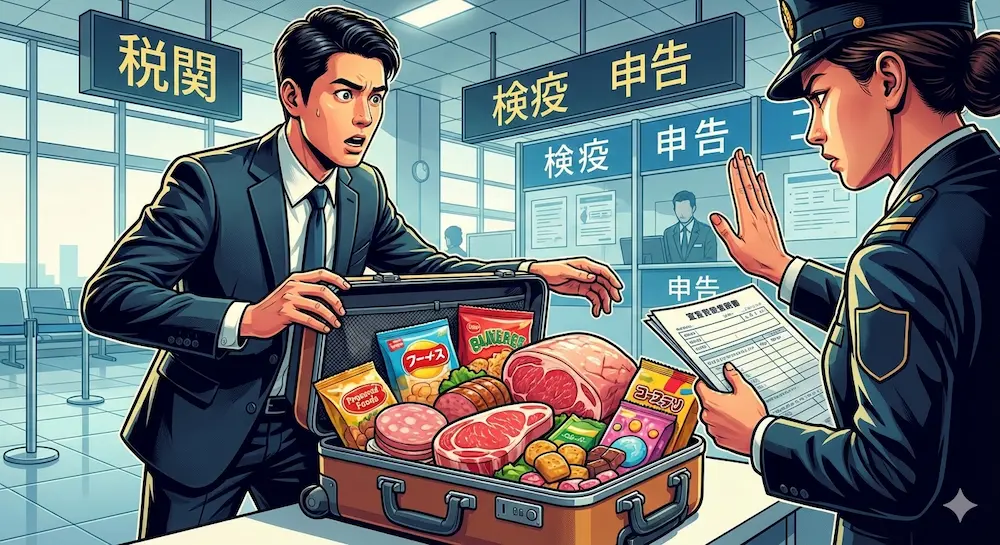
- “Are you bringing food into Japan?” → Always answer “Yes”
- Remarks column → “Food samples (not for sale)”
Answering “No” may be treated as non-declaration, which carries risks under the Customs Act and Food Sanitation Act.
Summary: Handling Hand-Carried Food Samples
- “No import declaration required” and “no NACCS declaration required” are often treated as equivalent in practice
- Food Import Notifications are a separate procedural layer
- Decisions are based on intended use × actual handling × ability to explain clearly
- Hand-carrying increases responsibility; preparation is critical
Q&A (Frequently Asked Practical Questions)
Q. If the quantity is under 10 kg, is a Food Import Notification always unnecessary?
A. No. Intended use takes precedence over quantity.
Q. Is there a monetary threshold?
A. No. Decisions are based on commercial intent, not value.
Q. What if an individual brings the items in?
A. If the purpose is corporate use, the individual must clearly explain that the items are managed under company control.
This article primarily addresses corporate use food samples.
Procedures and duty treatment differ for small-quantity imports under an individual’s name.
For individual small-quantity samples and simplified duty calculations (including the 60% rule), see the following article:
👉Can Individuals Import Food?
Practical Guidance on Small-Quantity Samples and the 60% Rule
Reference Materials
- Ministry of Health, Labour and Welfare: Imported Food Monitoring System
- Quarantine Office (FORTH): Imported Food Q&A
- Japan Tariff Association: Practical Customs Guidance
- Quarantine Office Prior Consultation Information