

Disclaimer:
This article is intended for general informational purposes only and does not guarantee outcomes for any specific transaction or customs determination. For actual import procedures, please confirm the latest laws, regulations, and instructions issued by customs and quarantine authorities.
Introduction
For companies importing food products, whether for the first time or with prior experience, common issues such as damaged goods, quality defects, and quantity discrepancies frequently occur upon arrival. Examples include:
- Partial shipment of frozen foods
- Products with shorter-than-agreed remaining shelf life
- Product damage due to broken packaging or temperature control failures
In food imports, the speed of initial response and accuracy of documentation are crucial for minimizing losses and ensuring successful claims with suppliers or insurers.
This guide provides a practical overview of handling quality and quantity issues, insurance claims, and the roles of warehouses and marine surveyors in food import operations.
1. Common Problems in Food Imports and Their Causes
1-1. Quality Defects
Typical Cases
- Differences in color, shape, taste, or odor from agreed specifications
- Deterioration caused by thawing or refreezing of frozen or chilled goods
- Contamination due to damaged packaging
Causes
- Manufacturing or quality control errors at overseas factories
- Temperature fluctuations or physical shocks during international transport (FAO: Cold Chain Management)
Explains the importance of temperature control in food transport, as outlined by the UN Food and Agriculture Organization - Inadequate inspection before shipment or upon arrival
For frozen and chilled products, any break in the cold chain can be critical. Objective evidence is required when filing insurance claims (ICC Marine Cargo Insurance)
Official ICC guidance on marine cargo insurance and Incoterms® rules.
1-2. Quantity Discrepancies (Shortage or Over-Shipment)
Typical Cases
- Fewer units than ordered
- Outer carton count matches, but inner contents are incomplete
Causes
- Packing or picking errors at the supplier’s warehouse
- Loss or theft during transportation
- Discrepancies between shipping documents (Commercial Invoice, Packing List) and actual goods (U.S. Customs and Border Protection: Importing Food Products)
Official US CBP guidance on managing food import documentation and quantities
Quantity discrepancies can also affect customs clearance, as declared quantities must match the physical shipment.
1-3. Inspection and Food Safety Issues
Typical Cases
- Shipments rejected or destroyed due to non-compliance with food safety regulations (FDA Food Import Guidance)
Authoritative reference on US FDA food import regulations - Failure to maintain proper temperature control for frozen or chilled goods
- Incorrect or missing labeling for ingredients, allergens, or country of origin
In all countries, health authorities typically conduct inspections either before or after customs clearance.
2. Practical Response Flow When Problems Occur
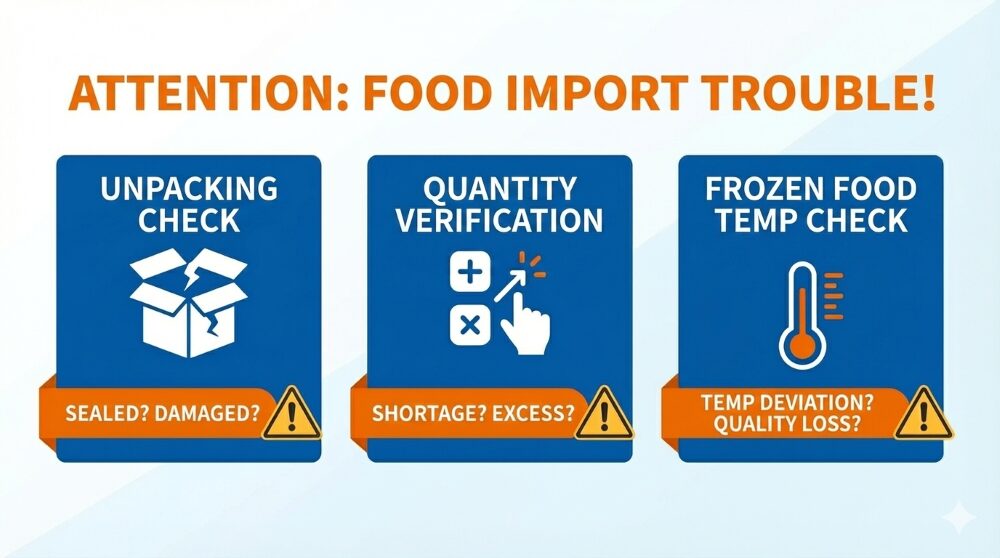
2-1. Inspection at the Time of Receipt (Critical Step)
Checkpoints
- Number of cartons and units
- Condition of outer and inner packaging
- Signs of thawing, condensation, or temperature abuse
- Expiration dates and lot numbers
Best Practices
- Take photos and videos before and during unpacking
- Instruct warehouse staff to report any abnormalities immediately
- Retain temperature data loggers if used (FAO: Temperature Data Loggers for Food Transport)
Explains methods and importance of recording transport temperatures
Accurate records are essential for supplier negotiations and insurance claims.
2-2. Reporting to the Supplier
- Notify the supplier in writing immediately after confirming a problem.
- Include:
- Objective facts (e.g., “Ordered 50 cartons, received 45; 3 cartons damaged”)
- Photos, videos, and temperature records
- Proposed resolution (replacement, refund, or price adjustment)
Avoid emotional language and focus on objective information to facilitate smoother negotiations.
2-3. Insurance Claims and the Role of Marine Surveyors
If damage or loss likely occurred during transport, consider filing a marine cargo insurance claim under ICC clauses.
Claim Process
- Notify the insurer or broker immediately (Lloyd’s Marine Insurance)
Official Lloyd’s guidance on marine cargo insurance - Submit required documentation (Bill of Lading, Commercial Invoice, Packing List, photos)
- Arrange inspection by a marine surveyor
- Damage assessment and settlement
A surveyor provides an independent evaluation of the cause and extent of damage. Insufficient evidence may reduce or deny claims.
Insurance coverage depends on Incoterms® (FOB, CIF, etc.), so confirm when the risk transfers from seller to buyer (ICC Incoterms Rules)
Official ICC explanation of Incoterms® rules.
2-4. Coordination with Customs and Regulatory Authorities
- Procedures for returning, destroying, or abandoning damaged or non-compliant goods (World Customs Organization: SAFE Framework)
WCO framework for secure and compliant import operations - Handling of customs documentation and import permits
- Amendment of declarations when quantities differ
- Ensuring consistency of HS codes, declared values, and Certificates of Origin (COO)
3. Preventive Measures to Avoid Import Problems
3-1. Clear Contracts and Purchase Orders
- Product specifications and allowable tolerances
- Quantities and permissible variance
- Minimum remaining shelf life
- Transport temperature requirements
- Responsibility and procedures for defective or short shipments (UNCTAD: Contract Guidelines)
UNCTAD guidance on drafting clear trade contracts
3-2. Sample Approval and Pre-Shipment Inspection
- Approve product samples before mass production
- Use third-party pre-shipment inspection services (SGS Pre-Shipment Inspection)
Information on third-party inspection services for export quality verification - Obtain inspection reports and photos
These measures are especially effective when sourcing from suppliers with variable quality.
3-3. Insurance and Transportation Management
- Arrange sufficient marine cargo insurance (e.g., ICC(A) clauses)
- Use temperature-controlled containers for frozen and chilled goods
- Maintain clear communication among warehouse operators, freight forwarders, and customs brokers (International Maritime Organization: Cargo Transport)
IMO guidance on safe and secure cargo transportation
4. Summary
- Inspection and documentation at receipt are critical
- Warehouse staff play a key role in identifying and recording issues
- Marine surveyors provide independent evaluation for insurance claims
- Coordination with customs and regulatory authorities is essential
- Preventive measures—contracts, inspections, insurance, and documentation—significantly reduce risks
With accurate record-keeping and close collaboration among logistics, customs, and insurance partners, food import problems can be managed efficiently.
References
- FAO: Cold Chain Management
- ICC Marine Cargo Insurance
- U.S. Customs and Border Protection: Importing Food Products
- FDA Food Import Guidance
- FAO: Temperature Data Loggers
- Lloyd’s Marine Insurance
- World Customs Organization: SAFE Framework
- UNCTAD: Contract Guidelines
- SGS Pre-Shipment Inspection
- International Maritime Organization: Cargo Transport