

Roles of Importers, Customs Brokers, and Customs Authorities, with a Practical Checklist
- Introduction: For Those Unsure About Customs Clearance in Food Imports
- Role of the Importer and Key Practical Responsibilities
- Role and Advantages of Using a Customs Broker
- Role of Customs Authorities and Food Import Inspection Points
- Customs Clearance Workflow and Coordination Overview
- Pre-Import and Pre-Customs Clearance Checklist
- Summary
Introduction: For Those Unsure About Customs Clearance in Food Imports
If you are new to food imports, you may often wonder, “Who is responsible for what in customs clearance?”
Common concerns include:
- Customs clearance being suspended due to labeling or ingredient declaration issues
- Uncertainty about when and how to submit documents to Customs
- Questions about how much responsibility is transferred when hiring a customs broker
These issues form the “customs clearance maze” that almost every beginner encounters.
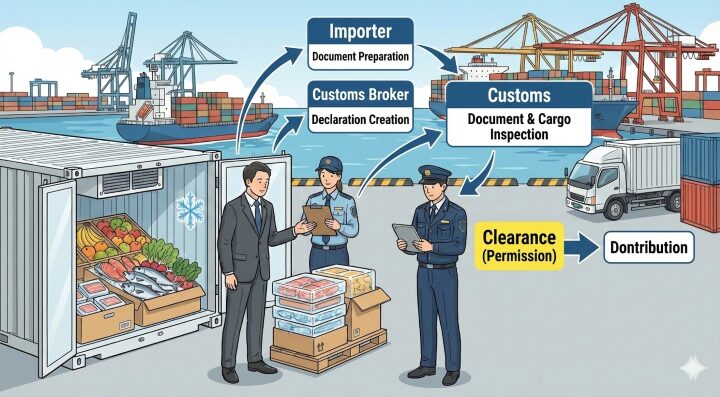
This article clearly explains the respective roles of importers, customs brokers, and customs authorities in food imports. Using practical figures, checklists, and a step-by-step workflow image, we help you avoid confusion in real-world operations.
Role of the Importer and Key Practical Responsibilities
Legal Responsibilities of the Importer
Under Japanese regulations, the importer is legally defined as the food importer and bears full responsibility for ensuring that imported food products are safe and compliant.
Key responsibilities include:
- Verifying ingredients and labeling in accordance with Japan’s Food Sanitation regulations
- Preparing required documents such as health certificates, commercial invoices, and packing lists
- Confirming that the products are not subject to import prohibitions or restrictions
Common Practical Mistakes and Risks
| Case | Cause | Risk |
|---|---|---|
| No Japanese-language label | Insufficient pre-import verification | Customs rejection, products cannot be sold |
| Incomplete ingredient list | Importer failed to prepare documentation | Shipment held for inspection, additional testing costs |
| Missing health certificate | Delay in issuance by exporting country | Customs clearance delays, risk of disposal |
Documents the Importer Must Prepare
| Document | Description | Notes |
|---|---|---|
| Import Declaration | Submitted to Customs | Can be filed by a customs broker |
| Commercial Invoice & Packing List | Cargo description | Must be accurate and consistent |
| Certificate of Origin (COO) | Required depending on product | Format varies by country |
| Health Certificate | Mandatory for food imports | Issued in exporting country and submitted to authorities |
Note: Documentation errors are the most common cause of customs clearance delays. Early preparation is critical.
Role and Advantages of Using a Customs Broker
Tasks Handled by Customs Brokers
A licensed customs broker (customs declarant) is a professional who conducts customs procedures on behalf of the importer.
In food imports, their main services include:
- Preparation and submission of import declarations
- Calculation and payment of customs duties and consumption tax
- Reviewing documents and correcting deficiencies
- Attending customs inspections and responding to inquiries
Customs Support in Numbers (Examples)
| Item | Typical Range |
|---|---|
| Customs duty rate (processed foods average) | 0–5% |
| Inspection period for frozen foods | 3–5 days |
| Customs broker service fee | JPY 5,000–20,000 per shipment |
Benefits and Points of Caution
Benefits
- Reduces documentation errors and declaration mistakes
- Smooth HS code classification and duty calculation
- Minimizes workload during inspections
Caution
A customs broker acts only as an agent. Responsibility for food labeling accuracy and ingredient compliance remains with the importer.
Role of Customs Authorities and Food Import Inspection Points
Core Functions of Customs Authorities
- Collection of customs duties and consumption tax
- Verification of cargo type and quantity
- Inspection of regulated goods such as food products
- Conducting on-site inspections when required
Examples of Customs Checks for Food Imports
| Food Category | Key Inspection Points | Notes |
|---|---|---|
| Fresh seafood | Health certificate, pesticide residue testing, temperature control | Mandatory inspection, results in 3–5 days |
| Frozen foods | Health certificate, packaging, storage conditions | Primarily random inspections |
| Processed snacks & canned foods | Ingredient labeling, import approval | Primarily random inspections |
Related article:
→ Common Quarantine Issues in Food Imports and How to Handle Them (Checklist by Product Type)
Customs Clearance Workflow and Coordination Overview
The standard workflow can be summarized as follows:
- Importer: Prepares documents and product information
- Customs Broker: Prepares declarations and submits to Customs
- Customs Authority: Reviews documents and conducts inspections
- After clearance: Cargo is released and collected
Tip: Ideally, all documents should be prepared before shipment (FOB or CIF stage), and the import declaration should be filed immediately upon arrival at the port.
Pre-Import and Pre-Customs Clearance Checklist
Before Import
- Confirm Japanese-language labeling compliance
- Prepare health certificates and certificates of origin (COO)
- Verify ingredient lists and food additives
Before Customs Declaration
- Review invoice and packing list details
- Confirm HS code classification and duty rate
- Share complete information with your customs broker
Before Inspection
- Ensure proper temperature control (frozen or refrigerated goods)
- Prepare copies of food inspection documents
- Correct and report any discrepancies immediately
Summary
- Importer: Responsible for food safety and document preparation
- Customs Broker: Handles declarations and inspection coordination
- Customs Authority: Collects duties and enforces regulatory compliance
By understanding the correct documents, figures, and workflow, you can prevent customs clearance issues and ensure smooth food import operations.
Related Articles
- How to Find HS Codes for Beginners: 3 Common Mistakes to Avoid
- Top 10 Common Problems in Food Import Customs Clearance and How to Solve Them (Essential Tips for Beginners)
- When Food Imports Are Subject to Mandatory Inspection and How to Avoid It
Reference Materials
- Ministry of Finance / Japan Customs: Customs Clearance Procedures
- Ministry of Health, Labour and Welfare: Food Import Notification System
- Japan Customs Brokers Association: Scope of Customs Brokerage Services
- Ministry of Agriculture, Forestry and Fisheries: Ensuring the Safety of Imported Foods