

Disclaimer:
This article is intended for general informational purposes only and does not guarantee outcomes for any specific transaction or customs determination. For actual import procedures, please confirm the latest laws, regulations, and instructions issued by customs and quarantine authorities.
Summary of Key Decisions
When importing food from the EU, the main decision factors are compliance with labeling requirements, origin documentation, and adherence to additive and pesticide standards.
Although EU regulations are rigorous, in practice having EU-compliant documents does not guarantee smooth clearance in Japan, and pre-shipment checks or additional inspections are often required.
Incorrect judgments can lead to mandatory inspections, customs delays, cargo returns, or product disposal, resulting in significant business risks.
Introduction: Why EU Foods Are Not Automatically “Safe”
The EU is perceived as having strict food safety standards, but in practice:
- Labels are often in English, French, or German and may not meet Japanese labeling requirements.
- Additives or pesticide residue limits may differ slightly from Japanese standards.
- Certificates such as Health Certificates or Certificates of Origin may be incomplete.
Even EU products can get held at Japanese quarantine stations, so assuming EU origin equals guaranteed clearance is a common mistake.
General Principles for Importing EU Foods
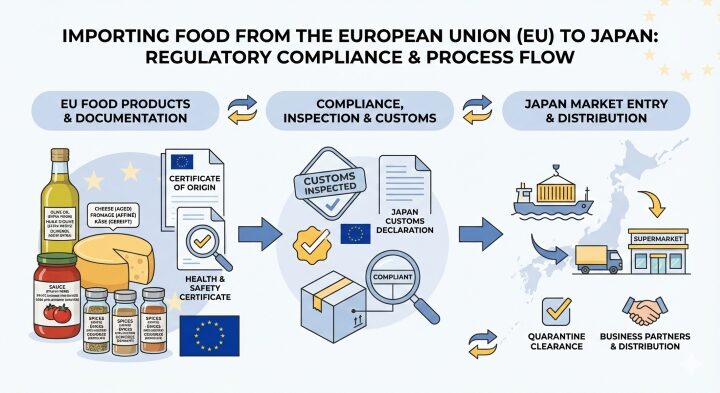
From a regulatory perspective, importing foods from the EU requires submission of a Japanese Import Notification under the Food Sanitation Act, and compliance with Japanese labeling and additive rules.
You might also find this article helpful.
→ Common Quarantine Issues in Food Imports and How to Handle Them | Food-Specific Checklist Included
Required Actions
- Submit the Import Notification to the appropriate quarantine office.
- Confirm that all ingredients and additives comply with Japanese standards.
- Ensure labels are translated and formatted according to Japanese regulations.
- Provide Health Certificates and Certificates of Origin as necessary.
For processed or composite foods (e.g., sauces, dairy products), pre-shipment verification of documents is strongly recommended.
For more information, see this article.
→ Definitive Guide to Food Import Preparation & Ingredient Labeling in Japan
Practical Points Where Decisions Often Differ
1. Additives and Pesticide Standards
While the EU uses E-numbered additives, Japanese regulations may have different limits or allowed substances.
- Simply showing an E-number is not sufficient.
- Compare EU and Japanese standards for each additive and residue limit.
- For complex foods such as processed sauces or snack products, pre-shipment testing or third-party analysis is advised.
2. Labeling Differences
- EU labels are typically in English, French, or German.
- Japanese law requires Japanese-language labels for ingredients, allergens, and expiration dates.
- Practical approach: Submit draft Japanese labels for pre-approval with quarantine authorities.
3. Origin and Health Certificates
EU exporters typically provide a Health Certificate and a Certificate of Origin (COO).
- Missing origin documentation may result in shipments being held.
- For processed products, unclear raw material origin can trigger additional requests.
- Best practice: Ensure traceable documentation for all ingredients.
Learn more about Certificates of Origin and how they work in import procedures in our detailed guide
→ Certificates of Origin for Food Imports: Complete Guide for Importers
Case-Based Practical Guidelines
Single-Ingredient Foods
Examples: wheat flour, olive oil, canned vegetables
- No additives
- Clear raw material source
Decision: Usually straightforward; pre-shipment inspections can often be skipped.
Composite or Processed Foods
Examples: sauces, cheese-containing sauces, snacks
- Multiple additives
- Complex ingredient lists
Decision: Pre-shipment testing and consultation with authorities are strongly recommended for first-time imports.
Risks of Incorrect Decisions
- Shipment flagged for mandatory inspection, leading to stricter future scrutiny
- Customs delays causing lost sales opportunities
- Cargo returns or product disposal
Note: EU food shipments with past compliance issues may face stricter review for all similar products.
For more information, see this article.
→ When Food Imports Are Subject to Mandatory Inspection and How to Avoid It
Expert Summary
- EU origin alone does not guarantee smooth clearance.
- Key decision factors: additives, labeling, certificates.
- Composite foods, dairy products, and processed sauces require pre-shipment checks and consultation.
- Seek professional advice for first-time or high-risk imports.
Practical Q&A
Q. Are EU organic certifications recognized in Japan?
A. Generally, no. They are considered reference information and not legally recognized under Japanese law.
Q. What precautions should be taken when importing EU dairy products?
A. Health Certificates and Certificates of Origin are required. Special checks may apply for lactose-free or processed cheese products.
Q. Are small EU food samples exempt from Japanese import notification?
A. Personal-use imports may be exempt, but distribution or sales require notification.
References
- Ministry of Health, Labour and Welfare, “Import Procedures for Food”
- European Commission Food Safety Guidance (English)
- EU Official Journal — Food Hygiene Regulations
- JETRO “Practical Guide to Food Imports from the EU”