

Disclaimer:
This article is intended for general informational purposes only and does not guarantee outcomes for any specific transaction or customs determination. For actual import procedures, please confirm the latest laws, regulations, and instructions issued by customs and quarantine authorities.
- Introduction
- What is a Certificate of Origin (COO)?
- When a COO is Required for Food Imports
- How to Prepare a Certificate of Origin for Food
- Common COO Issues and How to Avoid Them
- Food-Specific COO Checklist
- COO Workflow (Text-Based Flowchart)
- Best Practices for Food Importers
- International Considerations
- Summary
- References
Introduction
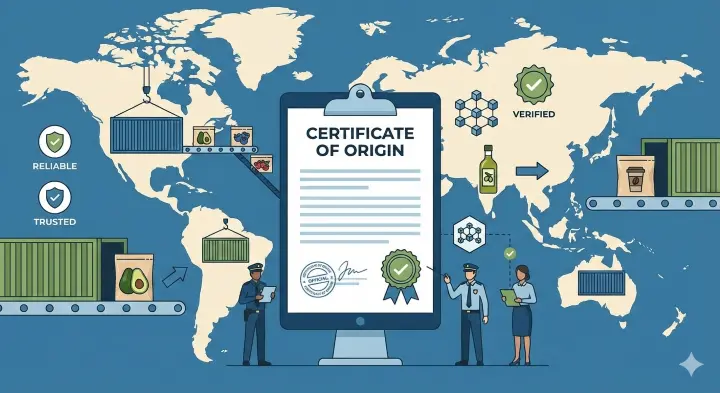
Certificates of Origin (COO) are essential in international food trade. They verify the country where the goods were produced and are often required for customs clearance, quarantine compliance, and preferential tariff claims under free trade agreements (FTAs).
Mistakes or omissions can lead to customs delays, denied imports, or loss of preferential tariffs, which can be costly for importers. This guide explains COO requirements for food, step-by-step preparation, common pitfalls, and best practices, with a practical food-specific checklist for easy reference.
What is a Certificate of Origin (COO)?
A Certificate of Origin is an official document used in international trade to certify the country of origin of goods.
Key Points for Food Imports:
- Confirms the country of production or processing
- Required for customs clearance in most countries
- Necessary to claim preferential tariff rates under FTAs such as Japan-EU EPA, CPTPP, ASEAN FTA
- Often submitted alongside HS codes, health certificates, and quarantine documents
- Can be issued by chambers of commerce, government authorities, or self-declared by exporters depending on the country
Types of COO:
- Non-preferential COO: Confirms origin for customs but does not affect tariffs
- Preferential COO: Required for FTAs to claim reduced import duties; must meet rules of origin
When a COO is Required for Food Imports
- Customs Clearance
- Many countries require COO to verify the declared origin of food products.
- Preferential Tariff Claims
- COO is necessary to apply reduced duty rates under FTAs.
- Quarantine and Regulatory Compliance
- Authorities use COO to assess eligibility for plant or animal quarantine, check prohibited species, or enforce regional restrictions.
Examples
- Fresh fruits from Chile: COO needed to claim preferential rates under the Japan-Chile Economic Partnership Agreement
- Unpasteurized cheese from France: COO confirms country of production for animal-derived product inspections
- Herbal teas: COO shows origin of raw herbs for plant quarantine compliance
You might also find this article helpful.
→ How to Legally Reduce Customs Duties and Consumption Tax on Food Imports
How to Prepare a Certificate of Origin for Food
Step 1: Confirm Requirements
- Determine if COO is required for the food and country of import
- Check if a preferential COO is needed for FTAs
- Verify acceptable issuing authorities (chamber of commerce, government, or exporter self-declaration)
Step 2: Gather Required Information
- Exporter and importer details
- Product description and HS code
- Quantity, weight, packaging
- Country of origin of raw materials (especially for processed foods)
Step 3: Complete and Verify the COO
- Ensure information matches invoices, packing lists, and customs documents
- Include signature, stamp, or digital verification
- For preferential COO, confirm rules of origin are satisfied
Step 4: Submission
- Submit COO along with other required documents (health or quarantine certificates) at customs
- Retain digital and physical copies for audits or verification
For more information, see this article.
→ Common Quarantine Issues in Food Imports and How to Handle Them | Food-Specific Checklist Included
→ How to Find HS Codes for Beginners: 3 Common Mistakes to Avoid
Common COO Issues and How to Avoid Them
| Issue | Cause | Example | How to Avoid |
|---|---|---|---|
| COO not accepted | Missing signature/stamp or incomplete info | Fresh fruit shipment delayed at Japanese port | Verify issuing authority; complete all fields |
| Mismatch with invoice or HS code | Discrepancy between COO and other documents | Unpasteurized cheese rejected for preferential tariff | Ensure all quantities, weights, and descriptions match |
| Incorrect preferential COO | Rules of origin not met | Processed snacks fail under ASEAN FTA | Confirm origin of all ingredients; check FTA rules before export |
| Self-declared COO rejected | Import country does not accept self-declared COO | Frozen vegetables COO not accepted by EU customs | Use chamber-of-commerce-issued COO when required |
Food-Specific COO Checklist
| Food Type | COO Type Required | Other Documents | Notes |
|---|---|---|---|
| Fresh fruits & vegetables | Preferential / Non-preferential | Plant quarantine certificate | Verify FTA rules; confirm no prohibited species |
| Dairy (cheese, yogurt) | Preferential / Non-preferential | Animal quarantine certificate, import notification | Include unpasteurized verification |
| Processed meat | Preferential / Non-preferential | Animal quarantine certificate, food sanitation notification | Confirm multi-origin ingredient compliance |
| Confectionery & seasonings | Preferential / Non-preferential | Food sanitation certificate | Check ingredient origin for preferential tariffs |
| Frozen & packaged foods | Preferential / Non-preferential | Food sanitation certificate, HS code verification | Ensure COO matches raw material origins |
| All categories | Non-preferential COO may be required | Customs declaration documents | Always verify latest regulations and country-specific requirements |
COO Workflow (Text-Based Flowchart)
- Exporter prepares COO request →
- Chamber of Commerce or authority verifies origin →
- COO issued (signed/stamped/digitally verified) →
- Exporter submits COO to importer →
- Importer submits COO with customs & quarantine documents →
- Customs clears shipment and applies tariffs
Tip: For multi-ingredient processed foods, trace ingredient origins carefully to meet rules of origin for preferential COO.
Best Practices for Food Importers
- Plan in advance: Include COO preparation in import schedules to avoid delays.
- Coordinate with exporters: Ensure understanding of document requirements, especially for FTAs.
- Cross-check documents: COO must match invoices, packing lists, quarantine, and health certificates.
- Stay updated: Rules of origin and COO requirements change regularly; verify with customs and FTA authorities.
- Leverage digital systems: Where accepted, submit digital COO to speed clearance and record-keeping.
International Considerations
- Japan: At the time of customs clearance, Japanese Customs determines the country of origin and the eligibility for preferential tariff treatment. Depending on the product and the applicability of an EPA/FTA, submission of a Certificate of Origin (COO) may be required. For food imports, the COO is reviewed in conjunction with plant and animal quarantine procedures administered by the Ministry of Agriculture, Forestry and Fisheries (MAFF) and food safety regulations overseen by the Ministry of Health, Labour and Welfare (MHLW).
- EU: At customs clearance, EU customs authorities assess the country of origin and eligibility for preferential tariff treatment. Depending on the product and the applicable FTA, submission of a Certificate of Origin (COO) may be required. For preferential treatment, compliance with EU rules of origin must be demonstrated through a COO or an origin declaration, as applicable.
- United States: At the time of importation, U.S. Customs and Border Protection (CBP) determines the country of origin and eligibility for preferential tariff treatment. Depending on the product and the applicability of an FTA, submission of a Certificate of Origin (COO) or an origin certification may be required. Under agreements such as the USMCA, specific origin certification or origin statements are required.
- China: During customs clearance, Chinese Customs verifies the country of origin and determines eligibility for preferential tariff treatment. Depending on the product and the applicable FTA, submission of a Certificate of Origin (COO) may be required. In practice, COOs verified and issued by chambers of commerce or other authorized bodies in the exporting country are often requested.
While the focus is on Japan, these principles generally apply globally, with local regulations checked for each import country.
Summary
- Certificates of Origin are essential for customs clearance, quarantine compliance, and preferential tariff claims.
- Key Steps for Importers:
- Determine if COO is required (preferential or non-preferential)
- Prepare accurate and verifiable COO documentation
- Match COO with invoices, HS codes, and quarantine documents
- Verify rules of origin for preferential tariffs
- Include schedule buffers for COO verification and customs processing
- Use the food-specific checklist and workflow to minimize errors, prevent delays, and ensure smooth food import operations.
References
- Japan Customs – Certificates of Origin
- Japan Chamber of Commerce & Industry – Export Certificates
- Japan Ministry of Agriculture, Forestry and Fisheries (MAFF) – Import Requirements
- World Trade Organization (WTO) – Rules of Origin
- European Commission – Certificates of Origin for Preferential Tariffs