

Disclaimer:I am an experienced practitioner in international trade, but I am not a licensed customs broker or administrative scrivener. The information provided here is for general guidance and practical reference only. For official advice or case-specific guidance, please consult the relevant Japanese customs authorities or a licensed professional.
- Quick Summary
- Introduction
- Why Japan’s HS Classification Often Feels Stricter
- Understanding HS Codes: Basics for Beginners
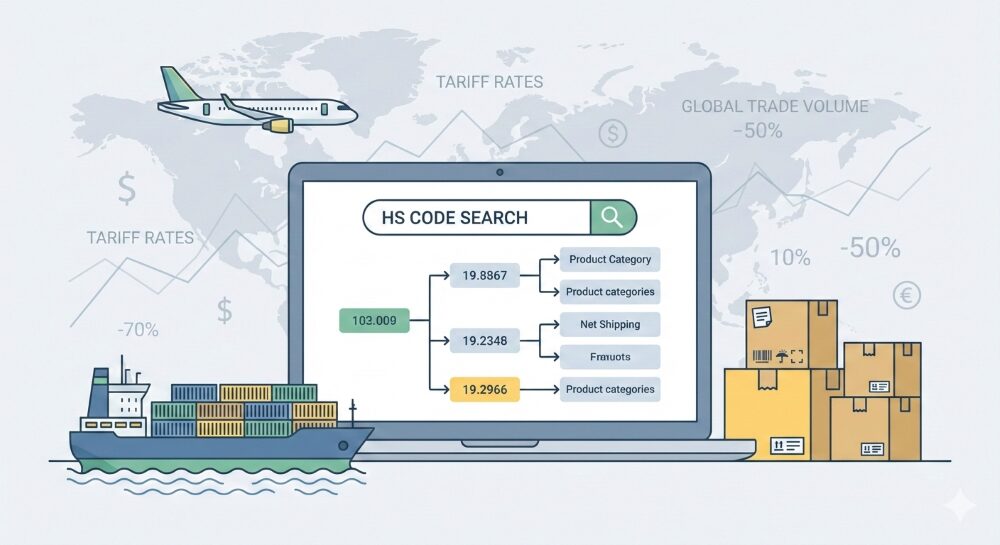
- How to Find HS Codes Using the Customs Tariff Search
- Examples of HS Codes for Common Products
- Common Beginner Mistakes
- What to Do if You Can’t Determine the HS Code
- If Customs Questions Your HS Code
- Summary: How to Approach HS Codes
- HS Code Q&A for Overseas Sellers
- Related Articles
- Reference Link
Quick Summary
This article explains how to correctly find and use HS codes for importing goods into Japan, highlighting common mistakes made by beginners. It also explains why Japan’s HS classification is stricter than in other countries and what overseas sellers need to know to avoid customs delays, reclassification, or duty adjustments.
Introduction
This article is based on my practical experience if you are importing goods into Japan, HS codes play a critical role in determining customs duties and regulatory requirements.
These codes determine taxes (customs duties) and import procedures. If used incorrectly, they can lead to unnecessary taxes or delays in import clearance.
HS Code (Harmonized System Code) is a globally standardized product classification code. In Japan, it is used for:
- Determining customs duty rates
- Import regulations
- Statistical management
Customs authorities use HS codes to:
- Set duty rates
- Determine whether an item is regulated
- Verify the accuracy of import declarations
If the HS code is ambiguous or incorrect, customs clearance is more likely to be delayed.
This guide explains, from a customs expert’s perspective, how beginners can correctly find and use HS codes, including common pitfalls and examples for food, general merchandise, and electronics.
Why Japan’s HS Classification Often Feels Stricter
Japan’s HS classification is often perceived as stricter than in other countries—not because the rules themselves are different, but because of how they are applied in practice.
In Japan:
- HS codes are interpreted conservatively
- Product details such as material, structure, and intended use matter more than commercial labels
- Importers are held fully accountable for classification decisions
- Customs authorities conduct thorough reviews when HS codes affect duties or regulations
For importers and overseas sellers, the key is not memorizing HS codes, but understanding the classification logic and being able to explain why a particular code applies.
Taking this approach greatly reduces the risk of customs delays, reclassification, and compliance issues when importing goods into Japan.
For a more detailed explanation, see:
👉Why Japan’s HS Classification Is Stricter Than Other Countries
Understanding HS Codes: Basics for Beginners
What HS Codes Are
- Definition: A globally standardized “product classification number”
- Official name: Harmonized System Code
What HS Codes Determine
- Customs duty rates: How much tax is applied
- Import regulations: Food inspections, Radio Law, Pharmaceuticals and Medical Devices Act, etc.
- Procedures: Whether a declaration or approval is required
Structure of an HS Code (Example)
4901.99-000
│ │ └─ Domestic 4-digit sub-classification
│ └──── HS 6-digit international code
└──────── HS 2-digit major category
HS codes are essential for import procedures and customs duty determination. Beginners often struggle with which code to select or where to search. This guide lays out the basic steps to find the correct HS code so that even first-timers can avoid mistakes.
Before searching, it’s helpful to understand at which stage the HS code is needed in the import process. For more context:
👉 What Is NACCS? – Japan Import Guide
👉A Step-by-Step Guide to Food Imports: 7 Essential Steps Explained with Diagrams for Beginners
How to Find HS Codes Using the Customs Tariff Search
Step 1: Open the Tariff Search
- Website: https://www.customs.go.jp/searchtc/jtcsv001.jsp
- Search “税関 Tariff検索” in Google and click the top result.
Step 2: Search by Product Name
- Enter the product name in the search box at the top.
- Examples: “coffee,” “notebook,” “headphones”
- Tip: Search in English for better results
- Use generic names, not brand names
Example: Coffee beans → “coffee beans”
Step 3: Select the Correct Item from the List
When multiple results appear, consider:
- Raw materials
- Processing status
- Usage
- Material
Choose the one that matches your product most closely.
Examples:
- Green coffee beans → 0901.11
- Roasted coffee → 0901.21
Step 4: Check Duty Rates and Regulations
Click the selected item to confirm:
- Duty rates (WTO, provisional rates)
- Import regulations (Food Sanitation Act, Radio Law, etc.)
- Notes and exclusions based on material or structure
Only after this step can you be confident you have the correct HS code.
Factors like material, usage, and processing significantly affect classification.
Examples:
- Food: Processed vs unprocessed
- Merchandise: Wood vs plastic material
- Electronics: Function or usage differences
Examples of HS Codes for Common Products
| Food | HS Code (6-digit) | Notes | Merchandise | HS Code (6-digit) | Notes | Electronics | HS Code (6-digit) | Notes |
|---|---|---|---|---|---|---|---|---|
| Green coffee beans | 090111 | Unroasted | Plastic cups | 392410 | Kitchenware | Wireless earbuds | 851830 | Bluetooth—Radio Law applies |
| Roasted coffee | 090121 | Roasted | Wooden spoons | 441990 | Wooden items | Laptop | 847130 | Data processing equipment |
| Chocolate | 180631 | Sugar content affects classification | Notebook (paper) | 482010 | Ring or no ring not relevant | Electric kettle | 851679 | Household electric appliance |
| Jam | 200710 | Fruit type may adjust classification | Synthetic leather bag | 420222 | Material important | LED lamp | 940540 | Household lighting |
Key Tips:
- Do not use the HS code from the exporting country; sub-codes differ by country.
Common Beginner Mistakes
① Classifying by product name alone
Using an HS code found online without verifying details is risky.
Customs checks why the code applies to your product.
② Ignoring material or usage
The same product name may have multiple HS codes depending on material or usage.
Examples:
- Metal parts vs plastic parts → different codes
③ Leaving it to the exporter
Suppliers’ HS codes often do not match Japanese customs standards.
The final responsibility lies with the importer.
For a more detailed explanation, see:
👉[Roles of Importers, Customs Brokers, and Customs Authorities, with a Practical Checklist]
What to Do if You Can’t Determine the HS Code
Sometimes there is no single “correct” code. In that case:
- Document why you selected the code
- Compare with other candidate codes
- Keep the explanation ready
In practice, importers combine:
- Past customs records
- Similar product examples
- Advance consultation with customs
If Customs Questions Your HS Code
Customs may say:
- “This HS code cannot be accepted.”
- “Consider another classification.”
Steps to handle this:
- Review the reason provided by customs
- Organize product information (specs, photos, etc.)
- Submit a corrected declaration or explanatory materials
You might also find this article helpful.
👉[10 Common Customs Clearance Problems When Importing Food into Japan — and How to Avoid Them]
Summary: How to Approach HS Codes
HS codes are not for memorization. You need to:
- Understand your product accurately
- Learn the classification logic
- Be able to explain your choice
Incorrect declarations can cause delays, duty adjustments, and reputational issues. By following these steps and understanding the key points, you can prevent most customs problems.
To understand why HS classification must be technically defensible,
it is important to understand how customs authorities interpret classification rules in practice.
The following books provide practical insights into tariff classification and customs decision-making:
HS Code Q&A for Overseas Sellers
Below are some common questions we receive from overseas sellers.
Q1. Can I use the HS code provided by my exporter or supplier when shipping to Japan?
Not necessarily.
HS codes used by exporters or suppliers are often based on their local customs standards, which may differ from Japan’s classification practices.
Even when the 6-digit HS code looks the same, the interpretation can vary.
In Japan, the importer is legally responsible for the declared HS code.
Exporters’ HS codes should be treated as reference information only and should always be reviewed before shipment.
Q2. Why does Japanese Customs question my HS code even though it was accepted in other countries?
Japan applies HS classification more conservatively, especially when classification affects:
- Customs duty rates
- Import regulations or inspections
- Safety or compliance requirements
Japanese Customs focuses on objective product characteristics—such as material, structure, and intended use—rather than commercial names or past acceptance in other countries.
As a result, an HS code accepted elsewhere may still be questioned or rejected in Japan.
Q3. What should I do if I am unsure which HS code applies to my product?
If classification is unclear, there may be more than one plausible HS code.
In such cases, it is important to:
- Compare candidate HS codes and understand their differences
- Document the reasoning behind your selection
- Prepare product specifications, photos, and technical details
Many importers also rely on:
- Past import records for similar products
- Consultation with customs brokers
- Advance discussions with Japanese Customs for high-risk or borderline items
Being able to explain why a particular HS code applies is often more important than finding a single “perfect” code.
Related Articles
Why Japan’s HS Classification Is Stricter Than Other Countries
A Step-by-Step Guide to Food Imports
Roles of Importers, Customs Brokers, and Customs Authorities
Reference Link
1️⃣ Japan Customs – Tariff Search
Official HS code and tariff lookup tool.
2️⃣ Japan Customs – Harmonized System Overview
Explains HS codes, classification, and duty calculations.
3️⃣ Japan Customs – Import Procedures & Regulations
Details import rules, procedures, and regulatory requirements.
4️⃣ Japan Ministry of Finance – Customs Handbook
Provides practical examples and guidelines for HS classification.