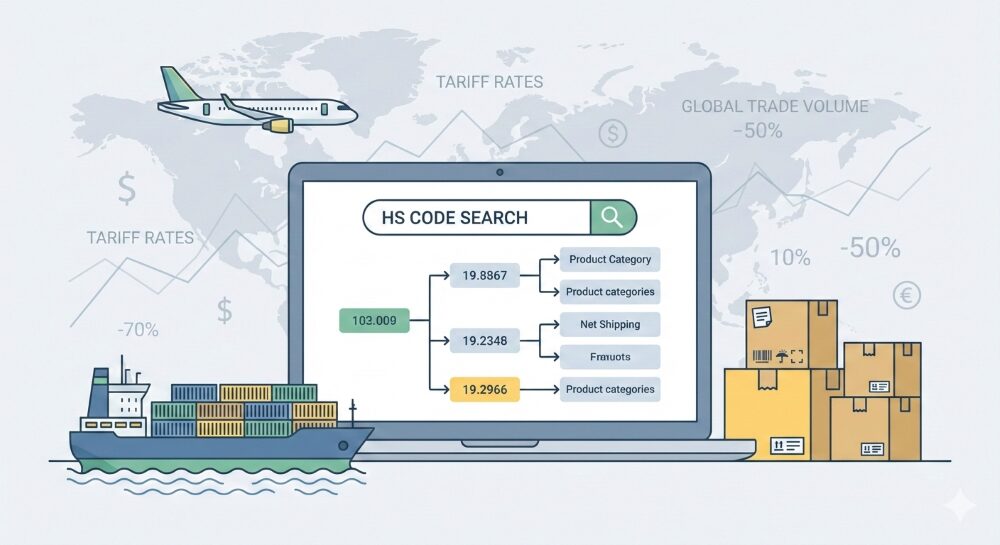


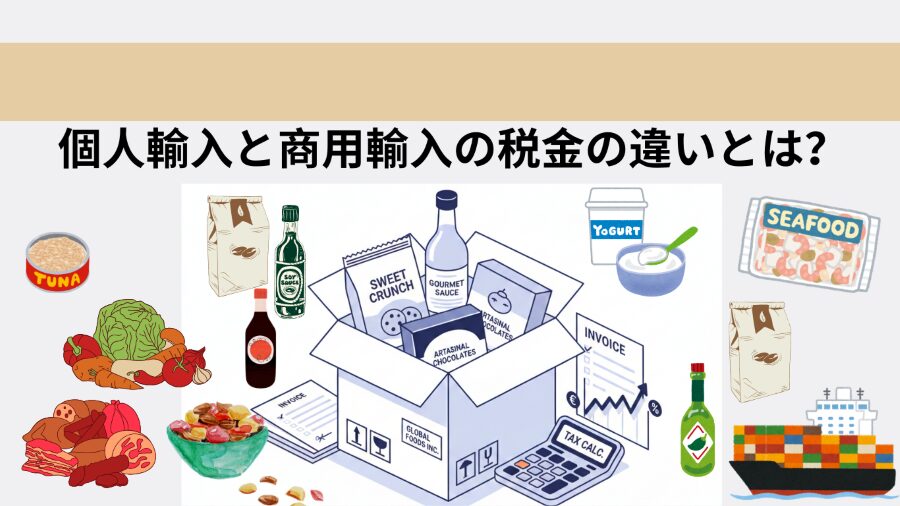
This article is intended to explain the general framework of customs duties and consumption tax. Actual tax amounts and treatment may vary depending on the product, contract terms, and declaration details. For individual cases, please confirm with customs authorities or a licensed customs broker.
A Practical Guide to Customs Duty and Consumption Tax Calculations Using Food Imports as an Example
This article explains how customs duties and consumption tax are calculated for food imports, from a practical, real-world perspective.
- Why “Taxes Are Higher Than Expected” in Food Imports
- The Key Conclusion First: Food Imports Are Almost Always “Commercial Imports”
- Differences in Tax Rules Between Personal and Commercial Imports
- Basic Tax Structure for Commercial (Food) Imports
- Understanding “Taxable Value” in Commercial Imports
- How Taxes Are Calculated for Food Imports
- Why There Is Such a Big Difference Between Personal and Food Imports
- In Food Imports, Classification Errors Are Riskier Than Taxes
- Common Misconceptions About Food Imports
- Summary: Always Assume “Commercial Import” for Food
- Reference Materials
Why “Taxes Are Higher Than Expected” in Food Imports
People who are new to food importing often say things like:
- “The taxes seem higher than what I found online.”
- “I followed an explanation for personal imports, but it didn’t match.”
- “I thought customs duty would be low, but the consumption tax is heavy.”
In most cases, the reason is simple:
👉 They are confusing the tax rules for personal imports and commercial imports.
This is especially critical for food imports, because:
- Almost all food imports are treated as commercial imports
- The personal import “60% valuation rule” does not apply
As a result, the tax calculation method is fundamentally different.
In this article, using food imports as the main example, we will explain for beginners to intermediate readers:
- The difference in tax rules between personal and commercial imports
- How customs duty and consumption tax are calculated for commercial (food) imports
- Common mistakes made in real import operations
The Key Conclusion First: Food Imports Are Almost Always “Commercial Imports”
Here is the most important takeaway upfront.
👉 Food imported for resale is, in principle, always treated as a commercial import.
- Corporations and sole proprietors → Commercial import
- Side businesses and small-lot imports → Commercial import
- Selling on Amazon or through retail channels → Commercial import
The idea that “small quantities qualify as personal imports” does not apply to food.
Differences in Tax Rules Between Personal and Commercial Imports
Comparison of Tax Calculation Rules
| Item | Personal Import | Commercial Import (Food) |
|---|---|---|
| Import purpose | Personal use | Resale / business use |
| Taxable value | Product price + freight × 60% | Product price + freight (100%) |
| Special rules | 60% rule applies | No special reduction |
| Duty rate | Often simplified rates | Official tariff rates |
| Consumption tax | 10% | 10% |
| HS code | Simplified | Formal HS classification required |
👉 The biggest difference: the 60% rule cannot be used for food imports.
Basic Tax Structure for Commercial (Food) Imports
There are two types of taxes paid when importing food:
① Customs Duty
- Duty rates vary by food category
- Processed foods and confectionery generally have duty rates
- Rates may also change depending on ingredients
② Consumption Tax
- Flat rate of 10%
- Applies even if customs duty is 0%
👉 Customs duty + consumption tax = total import taxes
For more detail, see:
→ How to Legally Reduce Customs Duty and Consumption Tax for Food Imports
Understanding “Taxable Value” in Commercial Imports
Taxable Value for Commercial Imports (Very Important)
For commercial imports, the taxable value is simply the total of:
- Product price (FOB or CIF value, depending on Incoterms)
- International freight
- Insurance (if applicable)
Taxable value = Product price + International freight + Insurance
👉 There is no 60% reduction.
If you think about this using the same logic as personal imports, it leads to the feeling that “taxes are too high.”
How Taxes Are Calculated for Food Imports
Step ① Calculate the Taxable Value
Example:
- Product price: JPY 100,000
- International freight: JPY 20,000
Taxable value = JPY 120,000
Step ② Calculate Customs Duty
Duty rates depend on the HS code and food category.
- Some food items: 0%
- Confectionery and processed foods: several percent to around 10%
Assuming a duty rate of 5%:
Customs duty = 120,000 × 5% = JPY 6,000
Step ③ Calculate Consumption Tax
For commercial imports, consumption tax is calculated as:
(Taxable value + customs duty) × 10%
Consumption tax = (120,000 + 6,000) × 10% = JPY 12,600
Total Taxes Payable
- Customs duty: JPY 6,000
- Consumption tax: JPY 12,600
- Total: JPY 18,600
👉 A key feature of food imports is that consumption tax accounts for a very large portion of the total tax burden.
Why There Is Such a Big Difference Between Personal and Food Imports
Even for the same product:
- Personal import: 60% valuation
- Commercial import: 100% valuation
This means the taxable value itself is different.
Example: Product + freight = JPY 120,000
- Personal import: 120,000 × 0.6 = JPY 72,000
- Commercial import: JPY 120,000
👉 This difference is the real reason taxes feel “higher than expected.”
In Food Imports, Classification Errors Are Riskier Than Taxes
In commercial (food) imports, tax rates may change due to:
- Incorrect HS code classification
- Misunderstanding of the food category
- Differences in ingredients and composition
👉 Attempting to reduce taxes through self-judged classification can result in post-clearance corrections or additional assessments.
Related article:
→ How to Find the Correct HS Code: Three Common Beginner Mistakes
Common Misconceptions About Food Imports
❌ “It’s a small quantity, so it’s a personal import.”
→ If it’s for resale, it’s a commercial import.
❌ “Customs duty is 0%, so taxes will be low.”
→ Consumption tax of 10% always applies.
❌ “I followed an article about personal imports online.”
→ Those rules do not apply to food imports.
Summary: Always Assume “Commercial Import” for Food
- Food imports are, in principle, all commercial imports
- The personal import 60% rule cannot be used
- Taxable value is 100% of product price plus freight
- Consumption tax has a larger impact than customs duty
- Accurate HS classification is the key to avoiding tax trouble
👉 Food import taxes are not “high” — the rules are simply different.
Once you understand this, cost calculations become much easier.
Reference Materials
1️⃣ Japan Customs: Differences Between Personal and Commercial Imports
https://www.customs.go.jp/english/index.htm
2️⃣ Japan Customs: How Customs Duties Work and How to Find Tariff Rates
https://www.customs.go.jp/tariff/
3️⃣ National Tax Agency of Japan: Treatment of Consumption Tax on Imports
https://www.nta.go.jp/english/index.htm
4️⃣ Ministry of Health, Labour and Welfare: Food Import Procedures (Commercial Basis)
https://www.mhlw.go.jp/stf/english/index.html