

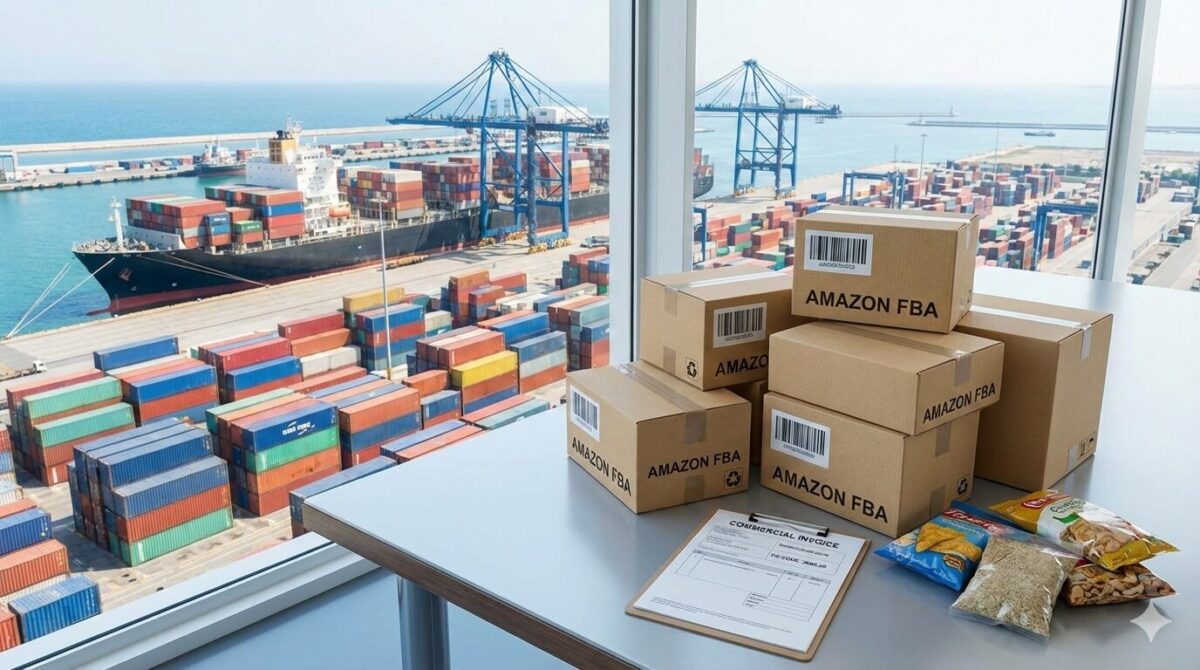
This comprehensive guide explains customs clearance, taxes, and delivery rules for Amazon FBA—topics that are currently drawing a lot of attention among sellers.
Among various Amazon business models, the most scalable and repeatable approach is “Western imports × Amazon FBA.”
However, importing for FBA requires specialized knowledge that often trips up beginners, including:
- Customs clearance procedures
- Import duties and consumption tax (VAT)
- Product regulations (pharmaceutical, food safety, and consumer protection rules)
- Amazon FBA inbound requirements
- Invoice preparation and labeling control
If you start without understanding these points, you may face serious issues such as:
- Shipments being held at customs
- FBA deliveries being rejected
- Goods being returned or destroyed
- Seller account suspension
In this article, even complete beginners with zero import experience will learn:
- What documents are required
- When and where taxes are imposed
- How to proceed with FBA inbound shipments
- How to handle regulated products (especially food imports)
- Practices that are strictly prohibited on Amazon
We explain everything clearly and step by step.
For further reading → Food Import Categories, Tariffs, and Total Import Cost Articles
- 1. Overview of the Amazon FBA Import Process
- 2. Documents Required for Import (With These, 90% of Customs Issues Are Avoided)
- 3. Typical Import Duty Rates for Common FBA Products
- 4. How to Calculate the Taxable Value (Essential for FBA Imports)
- 5. Mandatory Preparations Before Shipping to Amazon FBA
- 6. Amazon FBA Inbound Shipment Process
- 7. Examples of Products Prohibited by Amazon (High Risk)
- 8. Common FBA Import Problems and How to Prevent Them
- 9. Recommended Strategies for Beginners Starting FBA Imports
- 10. Conclusion: Mastering Imports + FBA Creates a Strong Business
1. Overview of the Amazon FBA Import Process
First, let’s understand the overall workflow.
Importing for Amazon FBA generally follows these eight steps:
Overall FBA Import Flow
- Product research
- Overseas sourcing (Amazon.com, eBay, wholesalers)
- Obtaining the commercial invoice
- Export and international transportation (FOB / CIF terms, etc.)
- Customs clearance
- Domestic delivery
- FBA labeling (in-house or via a prep service)
- Delivery to an Amazon FBA fulfillment center
The first major hurdle is customs clearance,
and the second is FBA inbound compliance.
Once these are cleared, Amazon handles storage, sales, and shipping almost automatically.
2. Documents Required for Import (With These, 90% of Customs Issues Are Avoided)
Customs clearance depends entirely on document consistency and accuracy.
Required Document ①: Commercial Invoice (Most Important)
An invoice issued by the overseas seller.
Mandatory information includes:
- Product description (in English)
- Quantity
- Unit price and total value
- Commercial use or personal use
- Country of origin (COO)
- Seller and buyer names
- Freight charges (international shipping cost)
Vague descriptions such as “accessory” or “fashion item” often cause customs delays.
Be specific, for example:
“Material: cotton / Product type: T-shirt.”
This level of detail is especially critical for food imports, where ingredient names, processing status, and intended use may be reviewed.
Required Document ②: Packing List
Lists quantity, weight, and dimensions for each carton.
👉 Managing invoices, packing lists, and cost calculations can be time-consuming, especially for beginners.
To simplify this process, you can use a practical Excel toolkit designed for import/export operations that helps you generate documents and calculate costs efficiently.
👉 starter toolkit for trade documentation
Required Document ③: Importer Code (Commercial Imports Only)
Required for shipments exceeding JPY 200,000 or for ongoing commercial sales.
This can be obtained from Japanese Customs through a free application, typically within 1–3 business days.
Required Document ④: Additional Documents (If Applicable)
- Food products → Food Import Notification (under the Food Sanitation framework)
- Cosmetics → Regulatory notification under pharmaceutical-related laws
- Electronics → Radio compliance certification
- Batteries → UN38.3 test summary
Regulated products—especially food and supplements—are where beginners struggle the most.
For a full English version of Japan’s food safety law, refer to the official Food Sanitation Act translation at the Japanese Law Translation website: https://www.japaneselawtranslation.go.jp/en/laws/view/5024. This outlines basic safety, labeling, additive controls, and inspection provisions that apply to imported food.
3. Typical Import Duty Rates for Common FBA Products
Import taxes consist of customs duty + consumption tax (VAT).
Customs duty rates are largely determined by product category and HS code.
Approximate Customs Duty Rates
- Apparel: 10–16%
- Footwear: ~30%
- Bags: 8–20%
- Watches: 0–4%
- Toys: 0%
- Electronics: 0%
- Sporting goods: 0–6%
- Household goods: 0–3%
Leather goods tend to have higher rates, while most electronics are duty-free.
Calculate import duties accurately and consider preferential tariffs using the resources from Japan Customs and JETRO FTA/EPA Guide.
Consumption Tax (VAT)
- 10% of the taxable value
- Paid at the time of import clearance
For food imports, additional inspection fees and testing costs may apply, depending on ingredients and processing methods.
4. How to Calculate the Taxable Value (Essential for FBA Imports)
For commercial imports, the so-called “60% rule” does not apply.
Taxable Value Formula (Commercial Import)
Taxable value = Product cost + International freight + Insurance
This taxable value is then subject to:
- Applicable customs duty rate
- 10% consumption tax
👉 To better understand total landed cost and profitability, you can also use a simple Excel-based profit simulation tool that automatically calculates import costs and margins.
👉 Excel toolkit for import/export operations
Example Calculation
- Product cost: JPY 100,000
- International freight: JPY 20,000
- Taxable value: JPY 120,000
Customs duty (10%): JPY 12,000
Consumption tax (10%): JPY 12,000
Total import taxes: JPY 24,000
5. Mandatory Preparations Before Shipping to Amazon FBA
After customs clearance, products must comply with Amazon’s inbound requirements.
① FNSKU Labeling
Each product must have one FNSKU (Amazon-specific barcode).
Options include:
- Labeling by the seller
- Outsourcing to a prep service
- Amazon’s paid labeling service (approx. JPY 20 per unit)
② Packaging Rules
Amazon’s packaging standards are extremely detailed.
Examples:
- Barcode must be visible through OPP bags
- Minimum protective thickness of 3 mm
- Set products must be labeled as “SET”
Violations can result in shipment rejection or return.
③ Prohibited Labeling Practices
- Concealing “Made in China”
- Adding promotional stickers
- Misusing the Amazon logo
All of these violate Amazon policy.
6. Amazon FBA Inbound Shipment Process
FBA Inbound Steps
- Create SKU in Seller Central
- Select FBA and generate an inbound shipment plan
- Enter carton size and weight
- Print shipment and box labels
- Choose a carrier
- International: DHL / FedEx
- Domestic: Yamato or Sagawa
- Deliver to the designated Amazon fulfillment center
Many beginners make mistakes when creating shipment plans, so outsourcing to a prep service is often a good option.
Even if products are intended for FBA, food imports follow a very different procedure from general merchandise imports.
In particular, you must understand the following before FBA:
- Food Import Notification submission
- Customs declaration procedures
- Electronic processing through NACCS
Food imports require prior review of ingredients, additives, shelf life, and labeling compliance.
We strongly recommend reviewing a dedicated, beginner-friendly overview of the food import process before proceeding.
What Is NACCS?
A Complete Beginner’s Guide to Japan’s Import Declaration System — Covering Procedures, Required Documents, Costs, Tax Rates, and Common Problems
7. Examples of Products Prohibited by Amazon (High Risk)
Even if customs clearance is successful, Amazon may still prohibit the product.
Common Prohibited Items
- Pharmaceuticals
- Cosmetics without proper approval
- Restricted supplement ingredients
- Battery-powered products without certification
- Food and beverages (subject to strict food safety review)
- Counterfeit branded goods
Counterfeit products almost always result in account suspension, so extreme caution is required when dealing with branded items.
8. Common FBA Import Problems and How to Prevent Them
Issue ①: Shipment Held at Customs
Causes:
Invoice errors, unclear ingredients, brand authenticity checks, pharmaceutical or food regulations.
Prevention:
Request a detailed materials and ingredients list from the supplier in advance.
Issue ②: FBA Delivery Rejected
Causes:
Incorrect labels, oversized cartons, set product rule violations.
Prevention:
Create a pre-shipment FBA compliance checklist.
Issue ③: Poor Profit Calculation
Many sellers fail to include customs duty and VAT.
Prevention:
Always calculate profitability using tax-inclusive landed cost.
👉 This is a common issue in import business. Using a structured cost calculation tool can help you avoid underestimating true landed costs.
👉 cost & profit calculation tool
Issue ④: Undeclared Dangerous Goods
- Sprays
- Alcohol-based products
- Batteries
These are classified as hazardous materials.
Prevention:
Use Amazon’s Dangerous Goods Classification tool.
9. Recommended Strategies for Beginners Starting FBA Imports
① Start with Low-Regulation Products
- Household goods
- Toys
- Simple electronic accessories (no radio certification required)
- Sporting goods
Leave pharmaceuticals, food, and wireless products for later stages.
② Use a Prep / Logistics Service
Highly effective if:
- You are uncomfortable with labeling
- English invoices are challenging
- You want to avoid customs delays
Prep services typically charge JPY 20–40 per unit for labeling.
③ Small Inventory, Fast Turnover
Cash flow is critical in FBA imports.
Avoid large initial orders.
10. Conclusion: Mastering Imports + FBA Creates a Strong Business
The biggest challenges in FBA imports are customs clearance and inbound compliance.
Key takeaways:
- Invoice and packing list accuracy is critical
- No “60% rule” for commercial imports
- Import taxes consist of customs duty + consumption tax
- FBA labeling and packaging rules are strict
- Regulated items and counterfeits are strictly prohibited
- Prep services make FBA accessible even for beginners
FBA importing is a knowledge-intensive business, but once the system is in place, it becomes a highly scalable model that can generate semi-automated monthly revenue.
Related Resources
- Amazon FBA Pre-shipment Preparation Guide (Official PDF)
Step-by-step instructions for preparing shipments into Amazon FBA, including importer of record (IOR)/Attorney for Customs Procedures (ACP) guidance.
🔗 https://s3.amazonaws.com/JP_AM/AGS/FBA_Pre-shipment_Preparation_Guide_EN.pdf - Japan Food Import Procedures (Ministry of Health, Labour and Welfare)
Government explanation of food sanitation import notification requirements under Japan’s Food Sanitation Act.
🔗 https://www.mhlw.go.jp/stf/seisakunitsuite/bunya/kenkou_iryou/shokuhin/yunyu_kanshi/kanshi/index_00004.html - Japan Customs Import Valuation for Amazon FBA Shipments
Detailed customs valuation methods for FBA shipments (CIF value, special valuation methods, HS/COO considerations).
🔗 https://acpjapan.jp/amazon_fba_japan_import_value/ acpjapan.jp