

Disclaimer
I am an experienced practitioner in international trade, but I am not a licensed customs broker or administrative scrivener. The information provided here is for general guidance and practical reference only. For official advice or case-specific guidance, please consult the relevant Japanese customs authorities or a licensed professional.
- Quick Summary
- Who This Article Is For
- Reason 1: Japan Prioritizes Objective Product Characteristics
- Reason 2: Exporter HS Codes Are Not Trusted by Default
- Reason 3: Japan Applies Conservative Risk Management
- Reason 4: Importer Accountability Is Extremely High
- Common Situations Where HS Codes Are Rejected in Japan
- How Importers Should Adapt to Japan’s Strict HS Classification
- Is There Ever a “Single Correct” HS Code?
- Practical Tips for Overseas Exporters
- Q&A: Overseas Exporters’ Concerns
- Reference Links
Quick Summary
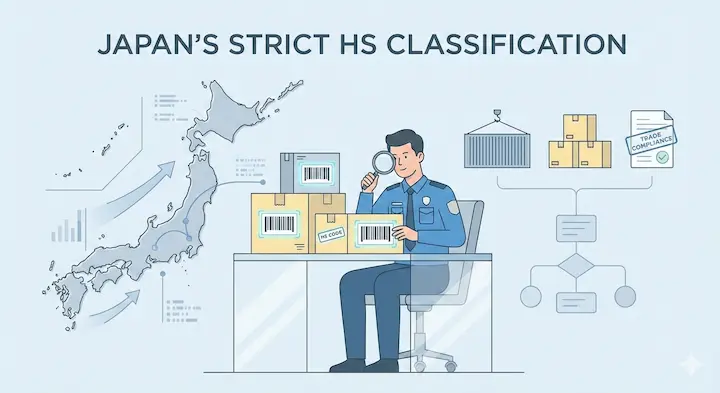
This article explains why Japan’s HS (Harmonized System) classification is often stricter than in other countries. Key reasons include conservative interpretation, the importance of objective product details, high importer accountability, and thorough customs scrutiny.
Overseas exporters and importers will learn practical strategies to reduce customs delays, avoid misclassification, and comply efficiently with Japanese import regulations.
For beginners, this complements our HS Codes for Beginners: 3 Common Mistakes to Avoid guide.
Who This Article Is For
This guide is written for:
- Foreign businesses exporting goods to Japan
- Overseas sellers involved in cross-border e-commerce
- Importers responsible for customs declarations in Japan
- Anyone who has experienced HS code disputes with Japanese Customs
Reason 1: Japan Prioritizes Objective Product Characteristics
Japanese Customs places strong weight on:
- Material composition
- Manufacturing process
- Physical structure
- Intended use at the time of import
Product names or commercial descriptions carry little weight on their own.
Example:
A product labeled as a “kitchen accessory” may be classified differently depending on:
- Plastic vs. silicone vs. metal
- Household vs. industrial use
- Electrical vs. non-electrical function
In some countries, broad commercial categories may be accepted. In Japan, classification must be technically defensible.
To understand why HS classification must be technically defensible,
it is important to understand how customs authorities interpret classification rules in practice.
The following books provide practical insights into tariff classification and customs decision-making:
For a beginner-friendly guide on HS codes, see How to Find HS Codes for Beginners.
Reason 2: Exporter HS Codes Are Not Trusted by Default
A common misunderstanding is:
“This HS code was used by the exporter, so it should be fine.”
In Japan, this assumption does not hold:
- Exporter HS codes are treated as reference information only
- Japanese Customs evaluates the product independently
- Final responsibility lies with the importer in Japan
Why This Matters:
Different countries apply different national sub-classifications and interpretations. Even when the 6-digit HS code appears identical, classification logic may differ.
Reason 3: Japan Applies Conservative Risk Management
Japanese Customs tends to adopt a risk-averse approach, especially for:
- Food products
- Chemical substances
- Electrical and wireless devices
- Medical or quasi-medical goods
If classification affects:
- Duty rates
- Regulatory requirements
- Safety inspections
Customs is more likely to question the declared HS code.
This strictness ensures:
- Legal compliance
- Consumer safety
- Accurate trade statistics
This articles helpful to understand at which stage the HS code is needed in the import process. For more context:
👉 What Is NACCS? – Japan Import Guide
👉A Step-by-Step Guide to Food Imports: 7 Essential Steps Explained with Diagrams for Beginners
Related:You might also find this article helpful.
👉 How to Legally Reduce Customs Duties and Consumption Tax on Food Imports
Reason 4: Importer Accountability Is Extremely High
In Japan, the importer is expected to:
- Understand the product in detail
- Select an appropriate HS code
- Explain why the code applies
HS classification is not treated as a “best guess.”
If customs challenges the classification, the importer must provide:
- Technical specifications
- Product catalogs or manuals
- Photos or samples
- Written explanations of classification logic
Common Situations Where HS Codes Are Rejected in Japan
HS code disputes frequently arise when:
- The product is processed but declared as raw
- The material is mixed or layered
- The function is multifunctional
- The product is new or uncommon
- The exporter’s HS code is copied without review
These cases often lead to:
- Customs inquiries
- Declaration amendments
- Delays in clearance
- Retroactive duty adjustments
You might also find this article helpful.
👉[10 Common Customs Clearance Problems When Importing Food into Japan — and How to Avoid Them]
How Importers Should Adapt to Japan’s Strict HS Classification
- Classify Based on Facts, Not Labels
- Ignore marketing terms. Focus on: Material, structure, function
- Prepare a Classification Rationale
- Be ready to explain: Why this HS code applies, why alternatives do not
- Keep Supporting Documents
- Specifications, manufacturer information, past import records
- Use Advance Consultation When Needed
- For borderline cases, consult: Customs brokers, past customs rulings, advance inquiries
For a more detailed explanation, see:
👉[Roles of Importers, Customs Brokers, and Customs Authorities, with a Practical Checklist]
Is There Ever a “Single Correct” HS Code?
Not always. Multiple HS codes may be plausible. Customs may accept one based on explanation and evidence. What matters most is that the classification is:
- Reasonable
- Consistent
- Explainable
Practical Tips for Overseas Exporters
- Verify supplier HS codes against Japanese Customs standards
- Document product specifications and classification logic
- Understand regulatory triggers (e.g., Food Sanitation Act, Radio Law, Pharmaceuticals Act)
- Use Japan Customs Tariff Search for official classification
Q&A: Overseas Exporters’ Concerns
Q1. Can I rely on my exporter’s HS code in Japan?
No. Exporter codes are treated as reference only; final responsibility lies with the Japanese importer. Always verify before shipment.
Q2. Why does Japan question a code accepted elsewhere?
Japanese Customs applies stricter, risk-averse criteria, especially for duties, safety, and regulatory compliance. Even minor differences in material or intended use may trigger questions.
Q3. How should I handle borderline products?
Compare candidate codes, document reasoning, and prepare supporting evidence (specs, photos, manuals). Advance consultation with customs or brokers is recommended.
Reference Links
- Japan Customs – Tariff Search – Official HS code and tariff lookup tool
Official HS code and tariff lookup tool for checking duties and classifications. - Japan Customs – Harmonized System Overview – HS code classification and duty explanations
- Japan Customs – Import Procedures & Regulations – Regulatory requirements for importers
- Japan Ministry of Finance – Customs Handbook – Practical guidelines for HS classification