


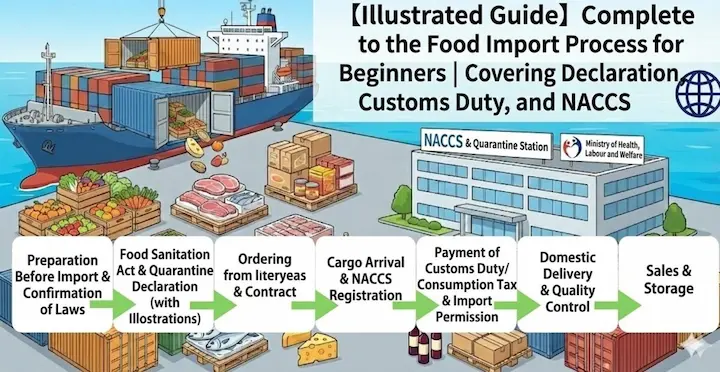
This article is written for those who are importing food products for the first time.
To make it easy to understand, we intentionally avoid excessive use of technical jargon.
You may be interested in importing food products, but feel stuck at the very beginning.
- Customs clearance? Quarantine? Documentation?
- Who should I consult first?
- Is it even possible for an individual to import food?
For first-time food importers, the sheer volume of procedures and unfamiliar terminology often becomes an immediate roadblock.
In this article, we break down the entire food import process—from start to finish—into seven clear steps, so even beginners can grasp the overall picture at once.
The key takeaway upfront
Most failures in food imports happen because people start moving without understanding the full process.
By reading this page to the end, you will clearly understand:
- The complete food import workflow
- What preparations you must do first
- Common pitfalls in customs clearance and quarantine procedures
- The Overall Food Import Process: Understand It in 7 Steps First
- [Step-by-Step] Food Import Procedures and Key Topics to Understand
- STEP 1: Determine Whether the Food Can Be Imported (Basic Legal Regulations)
- STEP 2: How to Choose International Trade Terms (Incoterms) and Key Precautions
- STEP 3: Obtain Ingredient Lists and Documents from Overseas Manufacturers
- STEP 4: Arrival in Japan and Import Declaration (NACCS)
- STEP 5: Food Import Notification and Preparation to Avoid Quarantine Delays
- STEP 6: Payment of Customs Duties and Consumption Tax
- STEP 7: Japanese Labeling, Sales, and Storage
- Recommended Reading Order for Beginners (Roadmap)
- FAQ for First-Time Food Importers
- 1. Can individuals import food products?
- 2. What should I do first when importing food?
- 3. What is the most common mistake in first-time food imports?
- 4. What documents are required for food imports?
- 5. Is a customs broker mandatory?
- 6. Is prior consultation with the quarantine station necessary?
- 7. How long does food import clearance take?
- Summary: Food Imports Are Not Scary Once You Understand the Process and Regulations
- Reference Links
The Overall Food Import Process: Understand It in 7 Steps First
Food imports generally follow the seven steps outlined below.
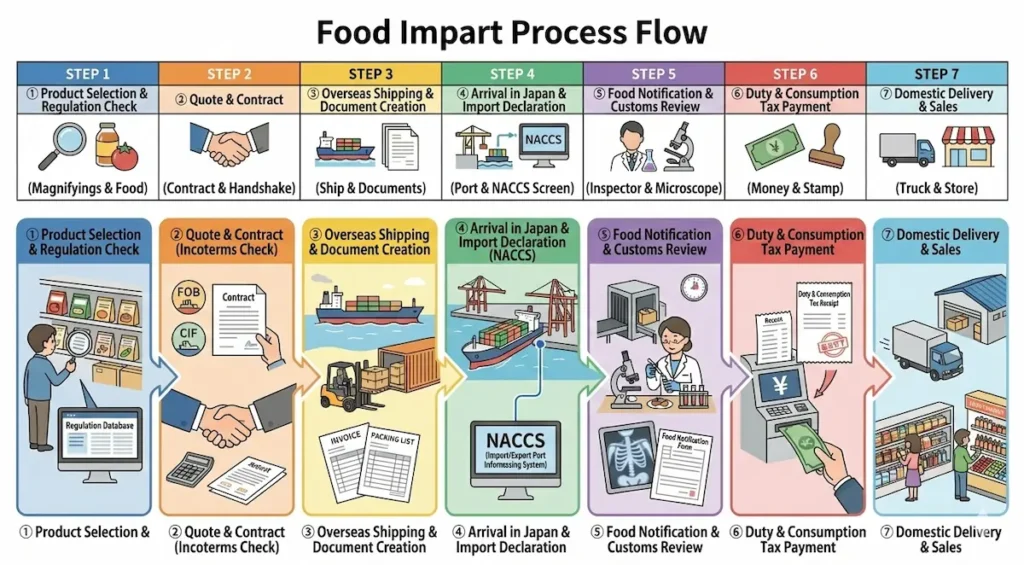
👉 If you understand this flow, you’ve already mastered about 80% of food import basics.
[Step-by-Step] Food Import Procedures and Key Topics to Understand
STEP 1: Determine Whether the Food Can Be Imported (Basic Legal Regulations)
Not all “food products” are treated the same.
Depending on whether the product is classified as general food, dietary supplements, or pharmaceuticals, the level of scrutiny on ingredients becomes significantly stricter.
Some ingredients or intended uses may make a product prohibited or subject to special approval.
Before importing, you must confirm that the product and its additives are not restricted under Japan’s Food Sanitation Act, which governs food safety and import regulations.
If regulatory checks are insufficient before import, customs clearance itself may be denied.
The golden rule:
Always obtain a full list of ingredients from the manufacturer before deciding whether the product can be imported.
If violations are discovered after import, consequences may include disposal, re-export, or even suspension of future imports.
Ingredient and additive verification affects not only customs and quarantine clearance, but also whether the product can legally be sold in Japan.
For a full English version of Japan’s food safety law, refer to the official Food Sanitation Act translation at the Japanese Law Translation website: https://www.japaneselawtranslation.go.jp/en/laws/view/5024. This outlines basic safety, labeling, additive controls, and inspection provisions that apply to imported food.
STEP 2: How to Choose International Trade Terms (Incoterms) and Key Precautions
Key points to confirm
- Unit price and quantity
- International freight cost
- Incoterms (FOB or EXW are generally recommended)
Important note for food imports
DDP (Delivered Duty Paid) contracts often make it unclear who the official importer of record is.
For food products, identifying the importer is critical, as that party bears legal responsibility under Japanese regulations.
📌 Key concept here
Incoterms (FOB, CIF, DAP, etc.) define the boundary of costs and risks between buyer and seller.
STEP 3: Obtain Ingredient Lists and Documents from Overseas Manufacturers
Required documents
- Commercial Invoice (food name, ingredients, and intended use are crucial)
- Packing List
- Bill of Lading (B/L) or Air Waybill (AWB)
- Certificate of Origin (COO), if applicable
Common mistakes with food imports
- Product names are too vague (e.g., “food” or “snack”)
- Missing country of origin or ingredient details
Incomplete or unclear documentation is a frequent cause of customs delays.
👉 For beginners, preparing these documents correctly can be one of the most challenging parts. Using a simple Excel toolkit for invoices, packing lists, and cost calculations can help streamline this process.
👉 starter toolkit for trade documentation
STEP 4: Arrival in Japan and Import Declaration (NACCS)
All food imports must be declared electronically through NACCS (Nippon Automated Cargo and Port Consolidated System), Japan’s centralized customs processing system.
This step includes:
- Import declaration to Customs
- Food import notification to the quarantine station
- Document review and, if required, inspection
📌 Key system to understand
👉NACCS is the backbone of Japan’s import clearance process.
STEP 5: Food Import Notification and Preparation to Avoid Quarantine Delays
Documents typically required
- Food Import Notification Form
- Ingredient list
- Manufacturing process chart
- Ingredient analysis report (if required)
Why beginners often get stuck
- Overseas manufacturers cannot provide required documents
- Insufficient Japanese translations
Main checkpoints during quarantine review
- Ingredients
- Food additives
- Manufacturing process
Depending on the product, authorities may order a mandatory inspection.
These inspections are not random; they follow identifiable risk patterns.
⚠️ For first-time food imports, this step usually requires the most time and effort.
However, once cleared, future imports of the same product become much smoother.
STEP 6: Payment of Customs Duties and Consumption Tax
Taxes payable
- Customs duty (determined by the HS code)
- Japanese consumption tax: 10% of (CIF value + customs duty)
📌 Key concept
Preferential tariffs often apply to food products.
👉 To better understand total costs and potential margins, it can be useful to run basic simulations using a structured cost calculation tool.
👉 Excel toolkit for import/export operations
By using FTAs or EPAs and submitting a valid Certificate of Origin, duties can be significantly reduced or eliminated[here].
To avoid classification mistakes, see our guide on using advance rulings for HS code determination [here].
STEP 7: Japanese Labeling, Sales, and Storage
Final checks before sale
- Japanese-language food labeling
- Country of origin
- Best-before or expiration date
Important warning
Labeling errors can result in sales suspension or product recalls.
One of the most common post-clearance issues is incorrect ingredient or food labeling.
For more information, see this article.
👉Definitive Guide to Food Import Preparation & Ingredient Labeling in Japan
Recommended Reading Order for Beginners (Roadmap)
If you’re wondering, “Where should I start studying?”, follow this order:
- Overall food import flow (this article)
- HS code basics for food classification
- Food import regulations and notification procedures
- NACCS and import declaration workflow
- Preferential tariffs and tax calculation
👉 Following this sequence will prevent confusion in real-world operations.
FAQ for First-Time Food Importers
1. Can individuals import food products?
Yes. Individuals can import food products.
However, regardless of whether the import is for personal use or resale, quarantine procedures under the Food Sanitation Act still apply.
2. What should I do first when importing food?
First, confirm that the food product is legally importable into Japan.
Do not place orders or prepare customs documents before verifying ingredients and additives.
3. What is the most common mistake in first-time food imports?
Importing without checking ingredients or additives.
Some additives legal overseas are prohibited in Japan.
4. What documents are required for food imports?
Typically:
- Invoice
- Packing List
- B/L or AWB
- Food Import Notification
- Ingredient and specification documents
5. Is a customs broker mandatory?
No, but for first-time importers, using a broker experienced in food imports usually saves time and prevents errors.
For more information, see this article[here].
6. Is prior consultation with the quarantine station necessary?
Not always, but strongly recommended if:
- It’s your first import
- Ingredients are unclear
- The product contains animal-derived materials
You might also find this article helpful.
👉Common Quarantine Issues in Food Imports and How to Handle Them | Food-Specific Checklist Included
7. How long does food import clearance take?
If no issues arise, clearance often completes within a few days to one week.
Inspections or document issues can extend this to several weeks.
Summary: Food Imports Are Not Scary Once You Understand the Process and Regulations
Food imports require more care than general merchandise, but they are manageable if you:
- Understand the overall process
- Identify common failure points in advance
- Learn the required knowledge step by step
To deepen your understanding further, explore articles on HS codes, preferential tariffs, and NACCS procedures.
Related article:
How to Find HS Codes for Beginners: 3 Common Mistakes to Avoid
What Is NACCS? – Japan Import Guide
Certificates of Origin for Food Imports: Complete Guide for Importers
Common Quarantine Issues in Food Imports and How to Handle Them | Food-Specific Checklist Included
Definitive Guide to Food Import Preparation & Ingredient Labeling in Japan
How to Legally Reduce Customs Duties and Consumption Tax on Food Imports
Reference Links
- JETRO (Japan External Trade Organization): Import Procedure Guides
- Japan Customs: Personal and Commercial Import Procedures
- International Chamber of Commerce (ICC): Official Incoterms® Rules
- Ministry of Health, Labour and Welfare (Japan): Food Sanitation Act Guidelines